BLACK FRIDAY: Get 20% OFF all subscriptions for life! Use code FCBF26 at checkout. See Offer
Ends in


 Spanish
 Italian
 French
 Russian
 Japanese
 Mandarin Simplified
 Mandarin Traditional
 Vietnamese
 Cantonese
 Shanghainese
 Taiwanese

Chinese Grammar Bank
How do Chinese numbers work?
Chinese numbers run on one pattern: learn 零 (líng) to 十 (shí), and you can build every number up to 99 by combining them. 25 is 二十五 (èrshíwǔ), literally “two ten five.”
Add four place words, 百 (bǎi, 100), 千 (qiān, 1,000), 万 (wàn, 10,000) and 亿 (yì, 100 million), and you can read prices, phone numbers, dates and ages. The numbers 一 to 十 are also HSK 1 vocabulary, so this is time well spent if your first exam is coming up.
Numbers open up conversations about shopping, birthdays, making plans, and more you might not expect (months and days of the week for example)! Chinese takes real work (here’s how difficult Chinese really is), but numbers are one of the quickest wins you’ll get.
This is not intended for learning in one day. If you are just beginning, focus on learning the numbers 0-10 and then counting up to 100.

- Chinese numbers 0 to 10
- Chinese numbers 11 to 100
- CHINESE NUMBERS BELOW 100,000
- READING NUMBERS WITH 0 IN THEM
- Big numbers: 万 (wàn) and 亿 (yì)
- DIFFERENCE BETWEEN 二 AND 两
- Using Chinese numbers in everyday life
- Lucky numbers, unlucky 4 and number slang
Chinese numbers 0 to 10
Let’s start with the basics! These 11 characters, from 零 (líng, zero) to 十 (shí, ten), are the building blocks for every other number. On their own, they already let you do things like telling someone the date!
| 0 | 1 | 2 | 3 | 4 | 5 | 6 | 7 | 8 | 9 | 10 |
|---|---|---|---|---|---|---|---|---|---|---|
| 零 | 一 | 二 | 三 | 四 | 五 | 六 | 七 | 八 | 九 | 十 |
| líng | yī | èr | sān | sì | wǔ | liù | qī | bā | jiǔ | shí |
Make sure to learn the numbers 0 to 10, because you’ll see them a lot on the rest of this page!
The number characters 零 to 十 are also a good first set of characters to write. Most take one to five strokes (零 is the odd one out, at 13), and they follow the basic rules: top to bottom, left to right, horizontal before vertical. So 十 (shí) is the horizontal line first, then the downstroke, and in 四 (sì) the bottom line goes on last to close the box. A stroke-order dictionary such as Arch Chinese or Pleco will animate each one for you.
To go a little further with these 10 Chinese Numbers, did you know Chinese people count with only one hand? Here’s how to do it:
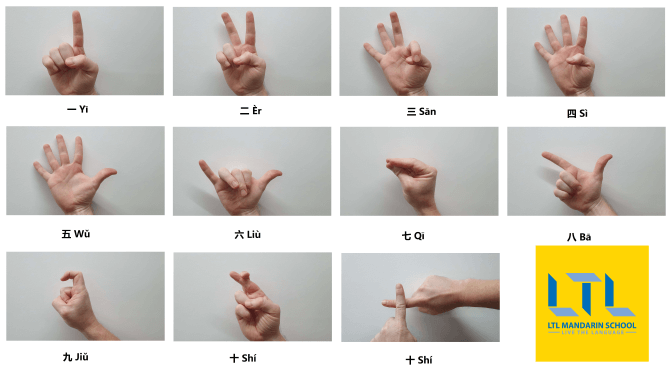
| Character | Pinyin | Number | One-hand gesture |
|---|---|---|---|
| 一 | yī | 1 | Index finger up |
| 二 | èr | 2 | Index and middle fingers up |
| 三 | sān | 3 | Three fingers up, usually middle, ring and little finger |
| 四 | sì | 4 | Four fingers up, thumb folded in |
| 五 | wǔ | 5 | Open hand |
| 六 | liù | 6 | Thumb and little finger out, the rest curled |
| 七 | qī | 7 | Fingertips of thumb, index and middle finger pinched together |
| 八 | bā | 8 | Thumb and index finger out, like an L |
| 九 | jiǔ | 9 | Index finger bent into a hook |
| 十 | shí | 10 | Clenched fist, or two fingers crossed |
Hand shapes vary a little from city to city, but 6 to 9 are the ones to learn, because they look nothing like Western counting. You’ll see them across market stalls all the time.
Chinese numbers 11 to 100
To count past ten in Chinese, you don’t need any new words. Every number up to 99 is built from 一 to 十, and the order of the characters tells you what they mean.
11 to 19: ten + digit
Put the digit after 十. 11 is 十一 (shíyī), literally “ten one,” and 19 is 十九 (shíjiǔ).
20 to 99: digit + 十 + digit
A digit in front of 十 multiplies it, and a digit after it adds. 20 is 二十 (èrshí), “two ten,” and 25 is 二十五 (èrshíwǔ), “two ten five.”
| Characters | Pinyin | Number | Built as |
|---|---|---|---|
| 十一 | shíyī | 11 | 10 + 1 |
| 十五 | shíwǔ | 15 | 10 + 5 |
| 十九 | shíjiǔ | 19 | 10 + 9 |
| 二十 | èrshí | 20 | 2 × 10 |
| 二十一 | èrshíyī | 21 | 2 × 10 + 1 |
| 三十 | sānshí | 30 | 3 × 10 |
| 四十八 | sìshíbā | 48 | 4 × 10 + 8 |
| 五十 | wǔshí | 50 | 5 × 10 |
| 六十六 | liùshíliù | 66 | 6 × 10 + 6 |
| 七十 | qīshí | 70 | 7 × 10 |
| 八十八 | bāshíbā | 88 | 8 × 10 + 8 |
| 九十九 | jiǔshíjiǔ | 99 | 9 × 10 + 9 |
| 一百 | yìbǎi | 100 | 1 × 100 |
One catch at 100: you need the 一. It’s 一百, never 百 on its own.
Chinese numbers 1 to 100 at a glance
| Range | …1 | …2 | …3 | …4 | …5 | …6 | …7 | …8 | …9 | …0 |
|---|---|---|---|---|---|---|---|---|---|---|
| 1 to 10 | 一 | 二 | 三 | 四 | 五 | 六 | 七 | 八 | 九 | 十 |
| 11 to 20 | 十一 | 十二 | 十三 | 十四 | 十五 | 十六 | 十七 | 十八 | 十九 | 二十 |
| 21 to 30 | 二十一 | 二十二 | 二十三 | 二十四 | 二十五 | 二十六 | 二十七 | 二十八 | 二十九 | 三十 |
| 31 to 40 | 三十一 | 三十二 | 三十三 | 三十四 | 三十五 | 三十六 | 三十七 | 三十八 | 三十九 | 四十 |
| 41 to 50 | 四十一 | 四十二 | 四十三 | 四十四 | 四十五 | 四十六 | 四十七 | 四十八 | 四十九 | 五十 |
| 51 to 60 | 五十一 | 五十二 | 五十三 | 五十四 | 五十五 | 五十六 | 五十七 | 五十八 | 五十九 | 六十 |
| 61 to 70 | 六十一 | 六十二 | 六十三 | 六十四 | 六十五 | 六十六 | 六十七 | 六十八 | 六十九 | 七十 |
| 71 to 80 | 七十一 | 七十二 | 七十三 | 七十四 | 七十五 | 七十六 | 七十七 | 七十八 | 七十九 | 八十 |
| 81 to 90 | 八十一 | 八十二 | 八十三 | 八十四 | 八十五 | 八十六 | 八十七 | 八十八 | 八十九 | 九十 |
| 91 to 100 | 九十一 | 九十二 | 九十三 | 九十四 | 九十五 | 九十六 | 九十七 | 九十八 | 九十九 | 一百 |
Tones to watch: 四十 vs 十四
四 (sì, 4) has a falling fourth tone and 十 (shí, 10) a rising second tone, so 四十 (sìshí) is 40 and 十四 (shísì) is 14. Locals practise with the tongue twister 四是四,十是十 (sì shì sì, shí shì shí), “four is four, ten is ten.”
一 changes tone too. Say yī when counting or reading digits, yì before first, second and third tones (一百 yìbǎi, 一千 yìqiān), and yí before a fourth tone (一万 yíwàn). Some tables on this page show the base tone yī, which is fine for reading but not how you’ll hear it.
CHINESE NUMBERS BELOW 100,000
Chinese numbers reflect different place values in a number. Here are all the characters you need to know to count up to 99,999! Don’t worry it all makes sense but there is one key thing to note here.
Important note: in English, numbers are separated with a comma after every 3 numbers, for example, 102,549. In Chinese, they are separated every four numbers when spoken.
| Characters | 万 | 千 | 百 | 十 |
| Meaning | wàn (10,000) | qiān (1,000) | bǎi (100) | shí (10) |
Now, consider the number 63,758. To know how to read a number in Chinese, you have to think of the place value of each number.
THE NUMBER 63,758 IS READ AS:
六万 三千 七百 五十 八
Before you get overwhelmed, let’s break this down by showing how this number is built, starting from the ones value (the number eight) and building up to the whole number.
| 8 | 八 |
| 58 | 五十 八 |
| 758 | 七百 五十 八 |
| 3758 | 三千 七百 五十 八 |
| 63758 | 六万 三千 七百 五十 八 |
See the pattern of the Chinese numbers here? It’s not too bad. Just remember a number wouldn’t be read as 63 thousand, but because of the IMPORTANT NOTE we mentioned above it reads as essentially 6 ten thousands, 3 thousands, 7 hundreds, 5 tens, 8.
If this sounds complex, just think of each part as a measure word like we’ve talked about before:
- 3 BOXES of…
- A FLOCK of…
- 6 THOUSANDS…
- 4 TEN THOUSANDS…
READING NUMBERS WITH 0 IN THEM
Things can get a little tricky when zero is included.
In the following list of numbers that have the number zero, note that the character for zero (零) is not used if the number ends in zero.
It is only used if the number zero is between two other non-zero numbers
Even if there are multiple zeros, like in the number 40070, only one 零 is used. Let’s have a look at some variations:
| 40 | 四十 |
| 407 | 四百零七 |
| 4007 | 四千零七 |
| 4070 | 四千零七十 |
| 4700 | 四千七百 |
| 40007 | 四万零七 |
| 40070 | 四万零七十 |
| 40700 | 四万零七百 |
| 47000 | 四万七千 |
TOP TIP || If you stumble upon a number and aren’t sure how to read it, paste it into Google Translate, set the translation to Chinese, and press the pronunciation button to hear how it’s said!
To make numbers stick, practise them where you’ll use them. Read price tags, bus numbers and license plates out loud in Chinese as you pass them, and save the ones that trip you up as flashcards in the Pleco dictionary app.
Big numbers: 万 (wàn) and 亿 (yì)
Again, remember our IMPORTANT NOTE on English vs Chinese numbers.
When you write Arabic numerals, Chinese groups them in threes just like English does: 624,000 or 624 000. The four-digit grouping happens when you read the number out loud, in blocks of 万 (wàn, 10,000) and 亿 (yì, 100,000,000).
万 covers four digits and 亿 covers eight, so 100,000,000 is 一亿 (yí yì). News reports and price tags often mix the two systems, like 3.2万 or 10亿, using the character for the big unit and numerals for the rest. Once this clicks, you’re ready for counting into the millions and billions.
For example, 32,000 is written 32,000 (or 3.2万 on a price tag) but read as 三万两千 (sānwàn liǎngqiān), literally “3 ten-thousands and 2 thousands.”
“Write in threes, read in fours.”
| Characters | Pinyin | Written number | Read in blocks of four |
|---|---|---|---|
| 三万两千 | sānwàn liǎngqiān | 32,000 | 3万 + 2000 |
| 五百四十八万九千二百零一 | wǔbǎi sìshíbā wàn jiǔqiān èrbǎi líng yī | 5,489,201 | 548万 + 9201 |
| 一亿 | yí yì | 100,000,000 | 1亿 |
| 十二亿三千四百五十六万七千八百九十 | shí’èr yì sānqiān sìbǎi wǔshíliù wàn qīqiān bābǎi jiǔshí | 1,234,567,890 | 12亿 + 3456万 + 7890 |
Past 亿 (yì, 100 million), the word for trillion depends on where you are. In Beijing or Shanghai, trillion is normally 万亿 (wànyì), which is 10,000 × 100 million, and 兆 (zhào) usually means million, the “mega” prefix, as in 兆 for megabytes. In Taipei, 兆 is the everyday word for trillion: 一兆 (yí zhào) is 1,000,000,000,000. When a figure looks huge, check which one the speaker means.
Here are the characters for how to pronounce bigger numbers or write them in character form.
Let’s consider the number 31,986,375. The number is written as 三千一百九十八万六千三百七十五.
| 3 | 1 | 9 | 8 | 6 | 3 | 7 | 5 | |
|---|---|---|---|---|---|---|---|---|
| Character meaning | 千 | 百 | 十 | 万 | 千 | 百 | 十 | |
| Place value | 10,000,000 | 1,000,000 | 100,000 | 10,000 | 1,000 | 100 | 10 | 1 |
Here’s how to write or say 31,986,375:
| 5 | 五 | wǔ |
| 75 | 七十五 | qīshíwǔ |
| 375 | 三百七十五 | sānbǎi qīshíwǔ |
| 6375 | 六千三百七十五 | liùqiān sānbǎi qīshíwǔ |
| 86375 | 八万六千三百七十五 | bāwàn liùqiān sānbǎi qīshíwǔ |
| 986375 | 九十八万六千三百七十五 | jiǔshíbā wàn liùqiān sānbǎi qīshíwǔ |
| 1986375 | 一百九十八万六千三百七十五 | yībǎi jiǔshíbā wàn liùqiān sānbǎi qīshíwǔ |
| 31986375 | 三千一百九十八万六千三百七十五 | sānqiān yībǎi jiǔshíbā wàn liùqiān sānbǎi qīshíwǔ |
👉 Note, this is not correct:三千万一百万九十八万六千三百七十五
You only say 万 once per four-digit block. Everything to the left of 万 (here 3198) is read as one number, 三千一百九十八, and then 万 goes on the end.
A few other slips to watch for:
- Dropping the 一: 100 is 一百 (yìbǎi) and 1,000 is 一千 (yìqiān).
- Skipping 一 before 十 in bigger numbers: 110 is 一百一十 (yìbǎi yīshí), not 一百十.
- Using 二 before a measure word: two cups is 两杯 (liǎng bēi), not 二杯.
- Adding 零 at the end: 4,700 is 四千七百, with no 零.
Curious about older number systems? Merchants once wrote prices in Suzhou numerals, 苏州码子 (Sūzhōu mǎzi), also called 花码 (huāmǎ). 1 to 3 are simple vertical strokes (〡, 〢, 〣), and the other digits get their own shapes. You won’t need them in daily life, since Arabic numerals and characters cover everything, but you might spot them on old price lists.
DIFFERENCE BETWEEN 二 AND 两
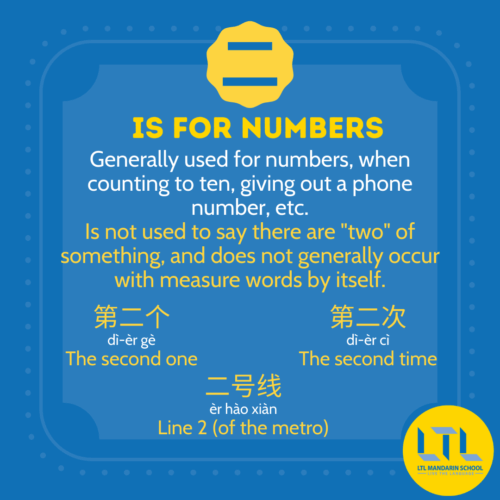
When do you use 二?
- #1 – To count or say a number on its own (二十, 二百), to read a phone number or other serial number digit by digit, and to make ordinals. Put 第 (dì) in front of a number and it becomes ordinal: 第一 (dì-yī, first), 第二 (dì-èr, second), 第三 (dì-sān, third). Ordinals keep 二 even before a measure word: 第二个 (dì-èr gè) is “the second one,” while 两个 (liǎng gè) is “two of them.”
- #2 – Before certain nouns, to express an implied “second。” For example 二月, which means February, is the second month. Similarly, 二楼 is short for “the second floor” of a building.
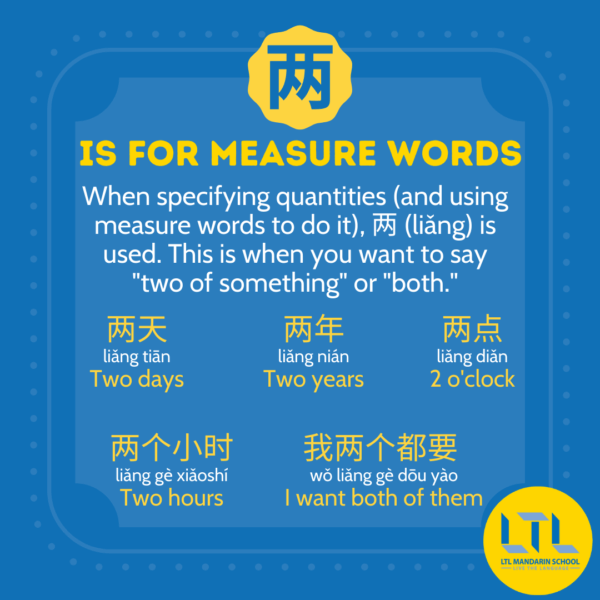
When do you use 两?
- #1 – 两 is used before a measure word (两个,两斤,两辆).
- #2 – It is also used before a noun that functions as a measure word. For example: 两年(two years), 两岁 (two years old).
So far, so good?
Exceptions to 二 or 两
Sometimes you can use 二 or 两 when expressing weight, length, or width, either word is acceptable:
- 二斤 (2 jin),两斤 (2 jin) *a jin is a commonly used measurement in China that is equivalent to half a kilogram (500 grams)
- 二厘米 (2 centimeters),两厘米 (2 centimeters)
Using Chinese numbers in everyday life
Phone and room numbers: 一 becomes yāo
When you read a phone, room or bus number digit by digit, say 一 as yāo (幺). That way it can’t be confused with 七 (qī) over a noisy line. In counting and math, 一 stays yī.
| Chinese | Pinyin | English |
|---|---|---|
| 我的手机号是139 1234 5678。 | Wǒ de shǒujī hào shì yāo sān jiǔ, yāo èr sān sì, wǔ liù qī bā. | My cell number is 139 1234 5678. |
| 我住1108房间。 | Wǒ zhù yāo yāo líng bā fángjiān. | I’m in room 1108. |
Saying your age
Use 我 + number + 岁 (suì). Remember 两 for two years old, but 二 inside bigger numbers: 两岁 (liǎng suì), but 二十二岁 (èrshí’èr suì).
| Chinese | Pinyin | English |
|---|---|---|
| 你多大? | Nǐ duō dà? | How old are you? |
| 你几岁? | Nǐ jǐ suì? | How old are you? (to a child) |
| 我二十五岁。 | Wǒ èrshíwǔ suì. | I’m 25. |
Years and dates
Read years digit by digit and add 年 (nián). When you write a year in characters, zero is usually 〇. Dates go from big to small: year, month, day. Use 日 (rì) in writing and 号 (hào) in speech.
| Chinese | Pinyin | English |
|---|---|---|
| 一九九八年 | yī jiǔ jiǔ bā nián | 1998 |
| 我是一九九八年出生的。 | Wǒ shì yī jiǔ jiǔ bā nián chūshēng de. | I was born in 1998. |
| 二〇二六年十月十六日 | èr líng èr liù nián shí yuè shíliù rì | October 16, 2026 |
| 今天十月十六号。 | Jīntiān shí yuè shíliù hào. | Today is October 16. |
Prices
On price tags you’ll see 元 (yuán), but in shops everyone says 块 (kuài).
| Chinese | Pinyin | English |
|---|---|---|
| 多少钱? | Duōshao qián? | How much is it? |
| 三十五块。 | Sānshíwǔ kuài. | 35 yuan. |
| 两块五。 | Liǎng kuài wǔ. | 2.50 yuan. |
Comfortable with whole numbers? Your next step is fractions and percentages with 分之. For even more number practice, check out our 👉 FULL Guide to Chinese Numbers.
Lucky numbers, unlucky 4 and number slang
So many Chinese words share sounds that numbers pick up meanings from the words they sound like. The big one: 4 is avoided because 四 (sì) sounds close to 死 (sǐ, death). Plenty of buildings skip the fourth floor, and a phone number full of 4s is a hard sell.
| Characters | Pinyin | Number | Why it matters |
|---|---|---|---|
| 四 | sì | 4 | Sounds like 死 (sǐ, death) |
| 十四 | shísì | 14 | Contains a 4, so floor 14 often goes missing too |
| 六 | liù | 6 | Sounds like 溜 (liū, smooth), as in 六六大顺 (liùliù dà shùn, everything goes smoothly) |
| 八 | bā | 8 | Sounds like 发 (fā), as in 发财 (fācái, to get rich) |
| 九 | jiǔ | 9 | Sounds like 久 (jiǔ, long-lasting) |
| 二百五 | èrbǎiwǔ | 250 | Slang for a fool, so don’t call anyone this |
Online, people take it further and text in numbers:
| Number | Pinyin | Sounds like | Meaning |
|---|---|---|---|
| 520 | wǔ èr líng | 我爱你 (wǒ ài nǐ) | I love you |
| 1314 | yī sān yī sì | 一生一世 (yìshēng yíshì) | Forever, for a lifetime |
| 886 | bā bā liù | 拜拜了 (bàibai le) | Bye-bye |
| 666 | liù liù liù | 溜 (liù, slick) | Nice one, well played |
For more, check out all of the Lucky Numbers to bring some Chinese culture to your learning!

Learn Mandarin with Flexi Classes
Book online classes with the best teachers in the industry.
FAQs
How do you count to 10 in Chinese?
Counting to 10 in Chinese means learning ten single-syllable characters:
1, 一 yī
2, 二 èr
3, 三 sān
4, 四 sì
5, 五 wǔ
6, 六 liù
7, 七 qī
8, 八 bā
9, 九 jiǔ
10, 十 shí
How do you say 10, 100, 1000 and 10,000 in Chinese?
10 – 十 shí
100 – 白 bái
1000 – 千 qiān
10,000 – 万 wàn
What numbers do they use in China?
Both. Arabic numerals (1, 2, 3) are what you’ll see on price tags, phone screens, buses and most signs, and Chinese characters (一, 二, 三) appear in writing, on menus and in formal text.
There’s also a third set, 大写 (dàxiě), used on checks, receipts and contracts because the strokes are hard to alter. For example, 1 is 壹, 2 is 贰, 3 is 叁 and 10 is 拾.
Why is 8 a lucky number in Chinese culture?
8 is a lucky number in Chinese culture because 八 (bā) sounds like 发 (fā), the first character of 发财 (fācái), to get rich or prosper.
How to write numbers from 1 to 10 in traditional Chinese?
Numbers from 1 to 10 are the same in simplified and traditional characters, so there’s nothing new to learn. A few bigger words do change: 万 (wàn, 10,000) is 萬 in traditional characters, and 两 (liǎng, two) is 兩.
How do you say ‘number’ in Chinese?
Number in Chinese is 数字 shùzì.
How do you count numbers in Chinese?
Chinese numbers run on one pattern. Learn the 11 characters from 零 (líng, 0) to 十 (shí, 10), and you can build every number up to 99 by combining them.
A digit in front of 十 multiplies it and a digit after it adds, so 25 is 二十五 (èrshíwǔ), literally "two ten five." For bigger numbers, add the place words 百 (bǎi, 100), 千 (qiān, 1,000), 万 (wàn, 10,000) and 亿 (yì, 100 million).
What is the meaning of 20 in Chinese?
20 in Chinese is 二十 (èrshí), literally "two ten." The 二 in front of 十 multiplies it, so 二十 means 2 × 10.
Add a digit after it to keep counting: 21 is 二十一 (èrshíyī) and 25 is 二十五 (èrshíwǔ).
Why is number 4 avoided in China?
The number 4 is avoided because 四 (sì) sounds close to 死 (sǐ), which means death. Many Chinese words share sounds, so numbers pick up meanings from the words they sound like.
Plenty of buildings skip the fourth floor, and floor 14 (十四, shísì) often goes missing too because it contains a 4. A phone number full of 4s is also a hard sell.
How to write Chinese "I love you"?
"I love you" in Chinese is 我爱你 (wǒ ài nǐ). Online, people often text it in numbers as 520, read wǔ èr líng, because it sounds like 我爱你.
Number slang like this works because many Chinese words share sounds. Another romantic one is 1314 (yī sān yī sì), which sounds like 一生一世 (yìshēng yíshì) and means forever, for a lifetime.
MORE FREE LESSONS
-
Chinese numbers: how to count from 0 to 100 million
- -
Chinese sentence structure: word order, questions and negation
S + V + O -
How to use 了 (le) in Chinese: verb 了 vs. sentence 了
Subject + Verb + 了 -
Chinese measure words
Number + Measure Word + Noun -
Chinese questions words
Subj. + 是 + 谁 ? -
How to write dates in Chinese
0000年 00月 00日 -
Asking and telling the time
00 点 00 分 -
Possessive particle 的
S + 的 + Noun -
Chinese negative form 不
不 + Adj / Verb -
The difference between 不 and 没
Subject + 不 / 没 + Verb -
How to use 吧
Suggestion + 吧 -
How to use 呢
Answer + S + 呢 ? -
How to use 吗
Statement + 吗? -
How to use 在
S+ 在 + Location + V -
How to use 要
S + 要 + Verb / Noun -
How to use 也
S + 也 + Verb / Phrase -
How to use 岁
S+ Number + 岁 -
How to use 太
S + 太 + Adj + 了 -
How to use 最
最 + Adj. -
How to use 离
Place 1 + 离 + Place 2 + Adverb of degree + 近/远 -
How to use 每
每 + (Measure word) + Noun -
How to use 别
别 + Verb (+ Object) -
How to use 第
第 + [Number] -
Saying "or" with 还是 or 或者
Option 1 + 还是 / 或者 + Option 2 -
Difference between 和 and 跟
S + 和 / 跟 + Person + V + O -
Difference between 能 and 会
Subject +(不)会/能 + Verb + Object -
How to use 想 and 要
Subject + 想要 + Noun/Verb -
Expressing "already" with 已经
Subj. + 已经 + Verb + 了 -
Saying “briefly” with 一下
S + Verb + 一下 -
How to use 不太
Subject + 不太 + Adjective/Verb -
How to use 怎么
S+ 怎么 + Verb / Adj ? -
How to use 都
S + 都 + V / Adj -
How to use 很
N + 很 + Adj