

 Spanish
 Italian
 French
 Russian
 Japanese
 Korean
 Mandarin Simplified
 Mandarin Traditional
 Vietnamese
 Cantonese
 Shanghainese
 Taiwanese
Japanese Counters Explained | How to Count in Japanese
Learn How to Count In Japanese

Counting in Japanese is both fascinating and a little tricky for learners.
Unlike English, where numbers are used on their own, Japanese uses counters: special words that attach to numbers depending on what you’re counting, whether it’s people, animals, objects, or even abstract things.
Because the counter changes with the item, mastering this system is an important part of learning Japanese. You’ll hear counters in everyday life—when shopping, ordering food, or even in cultural traditions—so they’re essential for fluency.
At first, the variety of counters can feel overwhelming, but with practice they quickly become second nature. In fact, learning them not only improves your Japanese but also gives you unique insight into how the language reflects culture and daily life.
In this article, we’ll introduce some of the most common Japanese counters and explain how and when to use them.
Japanese Counters || Basic and Versatile Counters
Japanese Counters || Mai
Japanese Counters || Chaku
Japanese Counters || Dai
Japanese Counters || Hiki
Japanese Counters || Hashira
Japanese Counters || FAQs

Japanese Counters || Basic and Versatile Counters
In Japanese, there are two very common ways to count general items: 〜つ (〜tsu) and 個 (こ / ko).
- 〜つ is the traditional Japanese way of counting. It’s mostly used up to ten and often taught first to beginners. Each number has a unique reading—for example, 一つ (ひとつ / hitotsu) instead of ichi-tsu.
- 個 (こ), on the other hand, is based on the Chinese-derived number system and is more standard in modern Japanese, especially for counting things in everyday life like apples, boxes, or pieces of something.
The tricky part is that with 〜つ, the numbers don’t follow the usual pattern and must be memorized individually.
| ENGLISH | つ WAY | 個 WAY |
| 1 | 一つ
ひとつ
hitotsu | 一個
いっこ
ikko |
| 2 | 二つ
ふたつ
hutatsu | 二個
にこ
niko |
| 3 | 三つ
みっつ
mittsu | 三個
さんこ
sanko |
| 4 | 四つ
よっつ
yottsu | 四個
よんこ
yonko |
| 5 | 五つ
いつつ
itsutsu | 五個
ごこ
goko |
| 6 | 六つ
むっつ
muttsu | 六個
ろっこ
rokko |
| 7 | 七つ
ななつ
nanatsu | 七個
ななこ
nanako |
| 8 | 八つ
やっつ
yattsu | 八個
はっこ
hakko |
| 9 | 九つ
ここのつ
kokonotsu | 九個
きゅうこ
kyuuko |
| 10 | 十
とお
tō | 十個
じゅっこ
jukko |
The counting with tsu is usually used to count up to 9 pieces; for 10 or more, 個 こ ko is used.

みっつください。
mittsu kudasai.
I’ll take three of them.
いつつください。
itsutsu kudasai.
I’ll take five of them.
十二個ください。
じゅうにこください。juuniko kudasai.
I’ll take twelve of them.
三十個ください。
さんじゅっこください。san jukko kudasai.
I’ll take thirty of them.
Although the Japanese language has numerous units, even the Japanese do not always master these diverse expressions. On a daily basis, we use units that can be easily used for countable things.
Japanese Counters || Mai
The Japanese language has many units for counting things. The meaning can be understood by saying hitotsu, futatsu and goko but using the correct unit of measurement makes the expression even more Japanese.
Below, you will learn about such various counting units and how to read them. This is the unit used to count thin sheets of material.
| JAPANESE | HIRAGANA | ROMAJI | ENGLISH |
|---|---|---|---|
| 一枚 | いちまい | ichimai | 1 |
| 二枚 | にまい | nimai | 2 |
| 三枚 | さんまい | sanmai | 3 |
| 四枚 | よんまい | yonmai | 4 |
| 五枚 | ごまい | gomai | 5 |
| 六枚 | ろくまい | rokumai | 6 |
| 七枚 | ななまい | nanamai | 7 |
| 八枚 | はちまい | machimai | 8 |
| 九枚 | きゅうまい | kyuumai | 9 |
| 十枚 | じゅうまい | juumai | 10 |
Examples:

CD二枚ください。
CDにまいください。si-di- nimai kudasai.
I’ll take 2 CDs.
チケット三枚ください。
チケットさんまいください。chiketto sanmai kudasai.
Three tickets, please.
The kanji 枚 consists of two parts: 木 and 攴.
木 means trees and 攴 means to beat, and it originally meant wood sticks to beat criminals.
Later, those sticks came to use for counting, and 枚 came to be used as counting units.

Japanese Counters || Chaku
着
ちゃくchaku
This unit is used to count clothing and other wearable items, where 着 means to wear.
| JAPANESE | hiragana | romaji | ENGLISH |
|---|---|---|---|
| 一着 | いっちゃく | icchaku | 1 |
| 二着 | にちゃく | nichaku | 2 |
| 三着 | さんちゃく | sanchaku | 3 |
| 四着 | よんちゃく | yonchaku | 4 |
| 五着 | ごちゃく | gochaku | 5 |
| 六着 | ろくちゃく | rokuchaku | 6 |
| 七着 | ななちゃく | nanachaku | 7 |
| 八着 | はっちゃく | hacchaku | 8 |
| 九着 | [きゅうちゃく | kyuuchaku | 9 |
| 十着 | じゅっちゃく | jucchaku | 10 |
Examples:
この服を三着ください。
このふくをさんちゃくください。kono huku wo sanchaku kudasai.
Please give me three of these clothes.

The original meaning of this kanji is to stick together, and for this reason it means to wear. It also has other meanings, such as arrival, and is used to indicate rank.
彼はレースで一着だった。
かれはレースでいっちゃくだった。kare wa re-su de icchaku datta.
He was first in the race.
Japanese Counters || Dai
台
だいdai
This is used to count cars, trains, rear carriages, and other objects used to carry people and things on top.
It is also used to count machines, computers, and electronic devices.
| JAPANESE | HIRAGANA | ROMAJI | ENGLISH |
|---|---|---|---|
| 一台 | いちだい | ichidai | 1 |
| 二台 | にだい | nidai | 2 |
| 三台 | さんだい | sandai | 3 |
| 四台 | よんだい | yondai | 4 |
| 五台 | ごだい | godai | 5 |
| 六台 | ろくだい | rokudai | 6 |
| 七台 | ななだい | nanadai | 7 |
| 八台 | はちだい | hachidai | 8 |
| 九台 | [きゅうだい] | kyuudai | 9 |
Example:
そこに車が二台停まっている。
そこにくるまがにだいとまっている。sokoni kuruma ga nidai tomatte iru
Two cars are parked there.
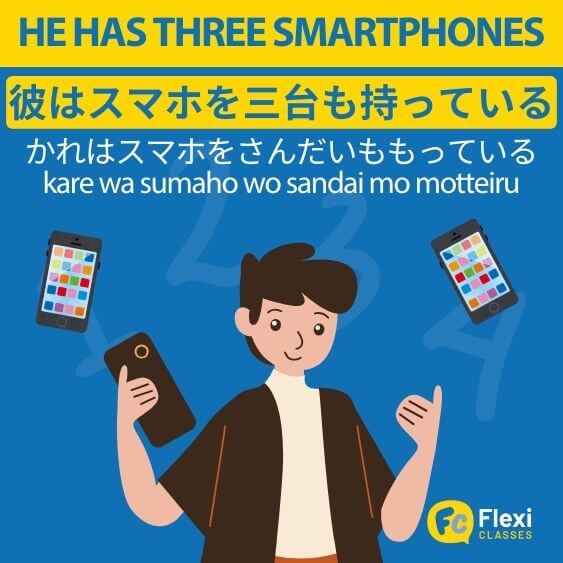
彼はスマホを三台も持っている。
かれはスマホをさんだいももっている。kare wa sumaho wo sandai mo motteiru.
He has three smartphones.
ルーターを一台貸してください。
ルーターを一いちだいかしてください。ru-ta- wo ichidai kashite kudasai.
Please lend me one router.

15 Japanese Tongue Twisters with Romaji and Audio 🗣️
Want to improve your Japanese pronounciation and have fun doing it? Check out these 15 Japanese tongue twisters with accompanying videos.
Japanese Counters || Hiki
匹
ひきhiki
This is the unit used to count insects and animals.
| JAPANESE | HIRAGANA | ROMAJI | ENGLISH |
|---|---|---|---|
| 一匹 | いっぴき | ippiki | 1 |
| 二匹 | にひき | nihiki | 2 |
| 三匹 | さんびき | sanbiki | 3 |
| 四匹 | よんひき | yonhiki | 4 |
| 五匹 | ごひき | gohiki | 5 |
| 六匹 | ろっぴき | roppiki | 6 |
| 七匹 | ななひき | nanahiki | 7 |
| 八匹 | はっぴき | happiki | 8 |
| 九匹 | きゅうひき | kyuuhiki | 9 |
| 十匹 | じゅっぴき | juppiki | 10 |
Example:

あそこに五匹の犬がいる。
あそこにごひきのいぬがいる。asoko ni gohiki no inu ga iru.
There are five dogs.
一匹のハエが飛んできた。
いっぴきのハエがとんできた。ippiki no hae ga tonde kita. /
One fly flew over.
In Japan, there are even dictionaries that collect only the above-mentioned counting methods. This is also an important part of the appeal of the Japanese language.
Colors in Japanese || A Complete Guide (+ FREE Quiz)
Japan is a country full of vibrant color, from its art and design to idyllic nature. Let’s learn how to say some of the most important colors in Japanese.
Japanese Counters || Hashira
Japanese culture is founded on polytheism, so there is more than one god. There is also a unit for counting such gods.
The 柱 はしら hashira is one such unit. Readings up to nine are listed below.
| COUNTER | HIRAGANA | ROMAJI | ENGLISH |
|---|---|---|---|
| 一柱 | ひとはしら | hitohashira | 1 |
| 二柱 | ふたはしら | hutahashira | 2 |
| 三柱 | みはしら | mihashira | 3 |
| 四柱 | よつはしら | yotsuhashira | 4 |
| 五柱 | いつはしら | itsuhashira | 5 |
| 六柱 | むはしら | muhashira | 6 |
| 七柱 | ななはしら | nanahashira | 7 |
| 八柱 | やつはしら | yatsuhashira | 8 |
| 九柱 | きゅうはしら | kyuuhashira | 9 |
A hashira is a pillar. Why do we count the gods this way?
Take a look at the kanji 柱. This kanji is consists of 木 and 主.
木 is, as seen above, trees.
主 means master, lord.
主 originally meant standing still there or supporting.
Since the time of the Kojiki and Manyoshu, Japanese people have believed that gods dwell in trees. From there, the notion that the gods are the ones who stand still in the trees and support the world was born, and this character came to be used to count the gods.
As we have seen above, knowing how to count is important for gaining a deeper understanding of the Japanese language and culture. Please find your favorite kanji and counting system and learn it with great interest.
Still confused? We’d love to help you, so drop your question here!
Japanese Counters || FAQs
What are Japanese counters?
Japanese counters are words used with numbers to count specific categories of things, like people, animals, or objects.
Do I need to memorize all Japanese counters?
Not at once! Start with the most common ones (like 人 for people, 本 for long objects, and 枚 for flat objects). Over time you’ll naturally pick up more.
What is the difference between 〜つ and 個 (こ)?
〜つ is the traditional Japanese counting system used mainly for numbers 1–10, while 個 (こ) is a more general counter used in modern Japanese for counting items.
How do you count clothes in Japanese?
Clothing is counted as 一着[いっちゃく]、二着[にちゃく]・・・]
How do you count gods in Japan?
In Japan, deities are counted using the unit “hashira(柱)”.
Why does Japanese use counters instead of just numbers?
Counters add clarity and precision, helping indicate what type of thing is being counted. For example, “two people” (二人 futari) is different from “two books” (二冊 nisatsu).
Want More From LTL?
WANT TO LEARN JAPANESE? Check out our online Japanese courses here.
We offer a 7-day free trial to all new students where you can study 24/7.
What about studying Japanese in Japan instead? We’ve got your back. Our Japanese courses in Tokyo can either be taken in small groups of no more than 5 students or individually for a more tailored experience.
We even offer incredible homestay experiences in Tokyo as well.
Come and be a part of this amazing community.