

 Spanish
 Italian
 French
 Russian
 Japanese
 Korean
 Mandarin Simplified
 Mandarin Traditional
 Vietnamese
 Cantonese
 Shanghainese
 Taiwanese
Obon in Japan: A Deep Dive into This Ancestral Festival
What is Obon? Unravelling the Traditions of this Japanese Festival
Obon (お盆 おぼん ) is a traditional Japanese Buddhist event, a period for welcoming and holding memorial services for the spirits of ancestors.
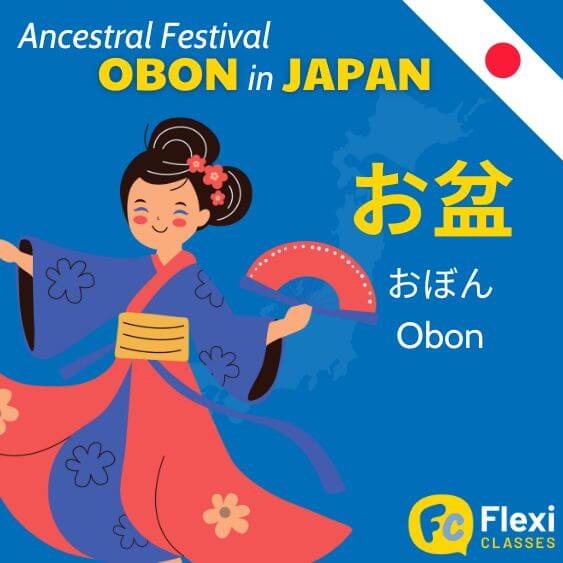
It is generally held every year from August 13th to 16th, and is considered an important summer event in many regions. During this period, many households in Japan welcome the spirits of their ancestors and hold memorial services for them.
Obon is more than just a holiday; it is an event with deep religious and cultural significance, and a great opportunity to understand traditional Japanese culture.
In this article, we’ll explain the origins of Obon and its modern-day customs in Japan.
Obon Festival || Obon
Obon Festival || Kisei
Obon Festival || Haka mairi
Obon Festival || Bon-odori
Obon Festival || Hanabi
Obon Festival || FAQs

Obon Festival || Obon
The word “Obon” is said to be an abbreviation of the Buddhist 盂蘭盆会 うらぼんえ urabon-e festival. The word originates from the Sanskrit word “Ullambana” (= the suffering of being hung upside down).
Once upon a time, a mother of a monk was sent to hell for being a nuisance to those around her because she loved her child too much. In hell, the mother was hung upside down and suffered the pain of having everything she ate and drank turn to fire.

When the monk consulted the Buddha, he was advised to gather the monks together on a summer day to make offerings and hold a memorial service for the deity. It is said that this ritual is the origin of the custom of Obon.
Obon is said to have been introduced to Japan around the 7th century, and the first Buddhist-style Obon memorial service was held in 657.
It is believed to have started to spread among the general public during the Kamakura period, and then, by the Edo period, it had become completely established among the common people.
Obon Festival || Kisei
Nowadays, very few families hold Buddhist memorial services. So, what they do is return to their parents’ home.
Returning to the house where you were born is called Kisei (帰省 きせい ). Kisei means someone who is, for example, from Hokkaido and normally works in Tokyo, returning to Hokkaido.
Although its Buddhist significance has faded, most Japanese people still take holidays during Obon. “Kisei” will be held during this period.
During consecutive holidays such as Obon, many Japanese people go on “Kisei” and public transportation becomes crowded, which is called Kisei rush (帰省ラッシュ きせいラッシュ ). Since it is common to take time off during Obon, a common social topic is asking what people will be doing during that time.

お盆休みはどうされますか?
おぼんやすみはどうされますか?Obon yasumi wa dou saremasuka?
What are you doing during the Obon holidays?
お盆には帰省します。
おぼんにはきせいします。Obon niwa kisei shimasu.
I will go back home for Obon.

Discover Tokyo // A Beginners Guide to Tokyo (Food, Transport + More)
Tokyo is an ideal destination for a trip, but you need to be well prepared. We’ve put together a guide to everything you need to know before you go to Tokyo.
Obon Festival || Haka mairi
It is common to visit the graves of relatives when returning home. To visit the graves are called 墓参り はかまい hakamairi.
People visit the grave bringing flowers to offer and tools to clean the tombstone. The biggest difference compared to kisei at other times of the year is whether or not people visit the graves.
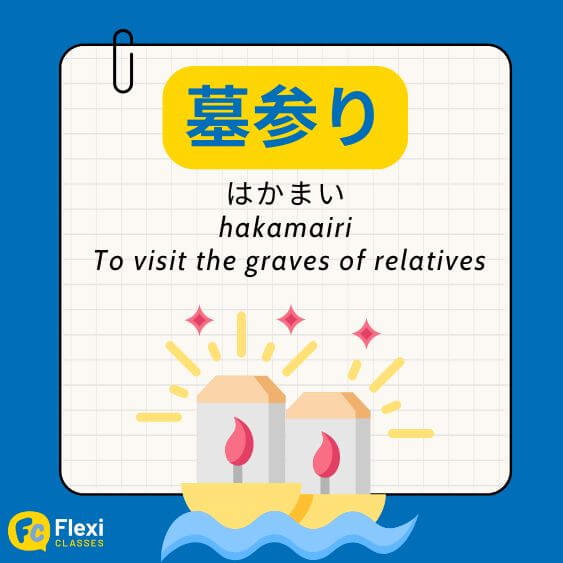
During hakamairi, the graves are cleaned, flowers are offered, and sticks of incense are burned.
The religious aspect of this festival has faded, and Buddhist ceremonies are rarely held. However, the idea that the souls of the dead, especially ancestors, return is still widespread, and eggplants or cucumbers pierced with chopsticks are sometimes displayed as vehicles for the souls of ancestors.
The cucumber represents a fast horse, and the eggplant represents a slow-moving cow. The meaning seems to be something like “Please come home toward us quickly on your horse” or “Please come back slowly on your way home on your cow.”
People who live in detached houses sometimes light a mukaebi(迎え火 [むか][び], welcome fire) in front of their house. This custom is no longer seen much these days as most people live in apartments.
Obon Festival || Bon-odori
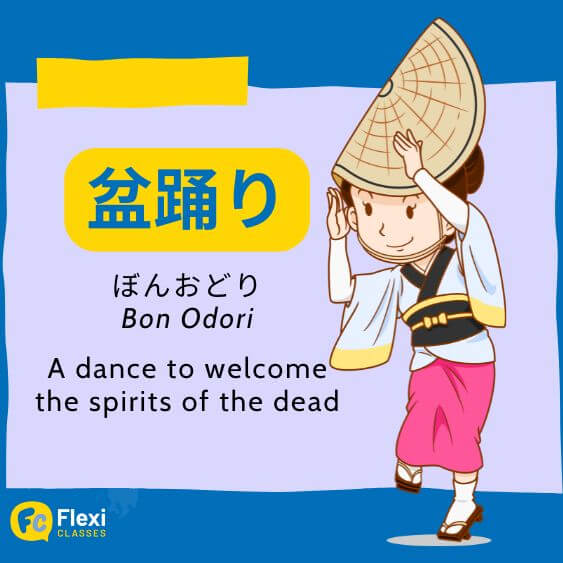
Summer festivals are also held during the Obon period. One of the attractions at these festivals is the “Bon Odori (盆踊り ぼんおどり ).” This is a dance to welcome the spirits of the dead, and is said to have started in the mid-Heian period.
At Bon Odori, people wearing masks or with their faces covered with towels may appear. This is said to represent the dead appearing among the living people.
A set of habits is said to represent the dead arriving on eggplants or cucumbers, being satisfied with the dancing and food, and then returning to the underworld.
Bon Odori has evolved into dances with unique characteristics in each region, and the Awa Odori (阿波踊り あわおどり ) dance of Tokushima Prefecture is particularly famous. 阿波 あわ Awa is the old name of Tokushima.
An En-nichi (縁日 えんにち , a festival) is held in conjunction with the Bon Odori. The streets are decorated with lanterns and flags, and food stalls are set up.
The stalls sell shaved ice (かき氷 かきごおり , kaki goori), frankfurters, beer, and more. Some people attend in their everyday clothes, but many people enjoy themselves in summer festival attire such as yukata (浴衣 ゆかた ).
Omikuji || Interpret your fortune in traditional Japanese way
How to Read an Omikuji and Interpret Your Fortune Are you interested in fortune-telling? Omikuji ( おみくじ ) is a traditional Japanese practice of fortune telling that anyone can try in Shinto shrines (神社: Jinjya) or Buddhist temples (寺:…
Obon Festival || Hanabi
Fireworks (花火 はなび , hanabi) are a symbol of summer in Japan. Today, the religious aspects of fireworks have completely faded and they are simply considered a part of the summer events, but they are said to have originally been part of the Obon rituals.
In some regions, fireworks are used instead of the Okuribi (送り火 おくりび , a fire-lighting ritual held on the final day of Obon to send home the spirits of ancestors).

Fireworks are seen as an act of sending off the spirits with bright light, like the Okuribi, and of praying for peace.
Events where fireworks are set off are called 花火大会 はなびたいかい (hanabi taikai, fireworks festival). The Sumida River fireworks festival (隅田川花火大会 すみだがわはなびたいかい ) in Tokyo is particularly famous, and each region has its own fireworks festival known to locals.
In Japan, fireworks are not just entertainment, but also a symbol of gratitude and prayer. Fireworks during Obon are a sign of respect and gratitude to ancestors, as well as a celebration of family and community ties.
As we have seen, Obon is not just a holiday, but an important occasion in Japan to welcome the spirits of the dead. Although the religious aspect of Obon has faded considerably, Japanese people are well aware of its significance. Learning more about the customs of Obon will deepen your understanding of Japanese culture.
Is there any festival in your country similar with Obon? Share the experience with us here!
Obon Festival || FAQs
What is Obon?
Obon (お盆 おぼん ) is a traditional Japanese Buddhist event, a period for welcoming and holding memorial services for the spirits of ancestors.
What do people do for the festival?
People return to their local homes, where ceremonies and festivals are held to welcome the spirits of the dead.
Why are eggplants and cucumbers decorated during Obon?
These vegetables are seen as vehicles for the spirits of the dead.
What is Bon Odori?
It is a dance to welcome the spirits of the dead. There are many variations depending on the region.
Why are fireworks festivals held during Obon?
It is said that the fireworks during the Bon Festival originated from the practice of lighting fires to see off the spirits of ancestors.
Want More From LTL?
WANT TO LEARN JAPANESE? Check out our online Japanese courses here.
We offer a 7-day free trial to all new students where you can study 24/7.
What about studying Japanese in Japan instead? We’ve got your back. Our Japanese courses in Tokyo can either be taken in small groups of no more than 5 students or individually for a more tailored experience.
We even offer incredible homestay experiences in Tokyo as well.
Come and be a part of this amazing community.