

 Spanish
 Italian
 French
 Russian
 Japanese
 Korean
 Mandarin Simplified
 Mandarin Traditional
 Vietnamese
 Cantonese
 Shanghainese
 Taiwanese
Chinese vs Japanese: Which is Harder to Learn? An Honest Comparison
TL;DR: Chinese and Japanese sit in exactly the same tier of the U.S. Foreign Service Institute’s difficulty rankings, both estimated at around 2,200 hours to professional proficiency for English speakers. They are not equally hard in the same places. Chinese is harder because of tones: four tones that change word meaning, a feature Japanese doesn’t have. Japanese is harder because of grammar and writing system complexity: three scripts, verb-final word order, and a multi-level honorific system that rewrites vocabulary and grammar depending on social context. For most English speakers the overall difficulty evens out at roughly the same level, but through completely different mechanisms.

Key takeaways:
- Both Mandarin Chinese and Japanese sit in the FSI’s hardest language category at approximately 2,200 hours to professional proficiency for English speakers.
- Chinese has four lexical tones; Japanese has a pitch accent system that is less demanding for English learners. This is Chinese’s single largest difficulty advantage over Japanese.
- Japanese has three writing systems (Hiragana, Katakana, and Kanji) versus one for Chinese. Japanese grammar is also more complex, with verb-final word order, particles, and a multi-level honorific system.
- Both languages use Chinese characters (Kanji in Japanese), but differently. Chinese character knowledge transfers to Japanese reading more than the reverse.
- The right choice is not the easier one; it is the one with the clearer use case in your life. Chinese covers more native speakers and more economic territory. Japanese has a uniquely concentrated cultural ecosystem.
Chinese and Japanese are the two languages most often compared when English speakers consider taking on an Asian language. Both sit in the FSI’s hardest category. Both involve character systems that take years to master. And both come with reputations that can feel discouraging before you have even begun.
This post gives you an honest, feature-by-feature comparison of where each language is harder, where they overlap, and how to decide which one makes more sense for your actual goals. For a full look at what makes Mandarin specifically difficult, see our guide to how hard Mandarin Chinese really is to learn.
Is Chinese or Japanese Harder | The Short Answer
Is Chinese or Japanese Harder | What the FSI Data Says
Is Chinese or Japanese Harder | Where Chinese Is Harder
Is Chinese or Japanese Harder | Where Japanese Is Harder
Is Chinese or Japanese Harder | Where They Are Similarly Demanding
Is Chinese or Japanese Harder | Grammar Head-to-Head
Is Chinese or Japanese Harder for English Speakers | Which Should You Choose?
Is Chinese or Japanese Harder | Frequently Asked Questions (FAQs)
Is Chinese or Japanese Harder: The Short Answer
Neither is clearly harder than the other overall. The FSI places both at approximately 2,200 hours to professional proficiency for English speakers, and no serious linguist or language educator argues otherwise. What differs is the location of the difficulty. Chinese is harder in one area: tones. Japanese is harder in a different set of areas: writing systems, grammar structure, and social register. For most English-speaking learners, the two languages are roughly equivalent in overall difficulty while presenting completely different types of challenge.
What the FSI Data Says
The U.S. Foreign Service Institute ranks both Mandarin Chinese and Japanese in Category IV, its hardest tier, alongside Arabic and Korean. The estimated hours to professional working proficiency are the same for both.
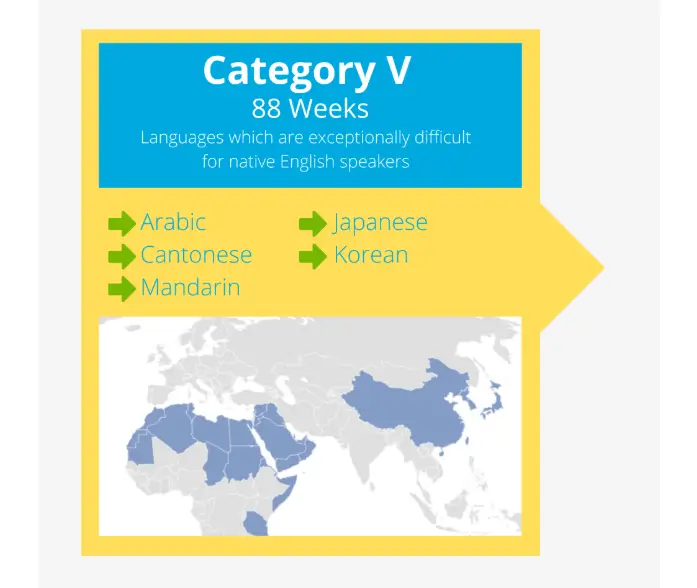
| language | fsi category | estimated hours | notes for english speakers |
|---|---|---|---|
| Mandarin Chinese | Category IV | ~2,200 h | Tones, characters, listening |
| Japanese | Category IV | ~2,200 h | Three scripts, grammar, honorifics |
| Korean | Category IV | ~2,200 h | Script, grammar structure, honorifics |
| Arabic | Category IV | ~2,200 h | Script, diglossia, sounds |
| Spanish / French | Category I | ~600–750 h | ~3x faster than Chinese or Japanese |
The 2,200-hour figure for both reflects professional working proficiency in a full-time diplomatic training programme, not conversational ability. For a breakdown of what different levels of Mandarin proficiency look like at different study paces, see our guide to how long it takes to learn Chinese.
Where Chinese Is Harder
Tones: the biggest single differentiator
Mandarin 普通話 (Pǔtōnghuà) has four tones plus a neutral tone. The tone of a syllable is part of its meaning: 买 (mǎi, “to buy”) and 卖 (mài, “to sell”) are identical syllables with different tones and opposite meanings. Getting tones wrong does not produce an accent; it produces a different word entirely.
Japanese does have pitch accent, a system where the pitch of syllables can change meaning in some words. But pitch accent in Japanese does not carry meaning in the same consistent, word-by-word way as Mandarin tones. Most Japanese words can be understood without perfect pitch, and pitch errors rarely produce catastrophic misunderstanding. Tone errors in Mandarin can and do.
Research confirms that learning tones is one of the most persistent challenges for English-speaking Mandarin learners, specifically because English uses pitch for social cues (emotion, questions) rather than word meaning. This mismatch doesn’t affect English-speaking learners of Japanese the same way.
Verdict: Chinese is significantly harder in this dimension. Japanese has no equivalent challenge.
Where Japanese Is Harder
Three writing systems versus one
Japanese requires learning three separate scripts:
| Script | Characters | Use |
|---|---|---|
| Hiragana | 46 syllable characters | Native Japanese words and grammar |
| Katakana | 46 syllable characters | Foreign loanwords, emphasis |
| Kanji | ~2,136 for basic literacy (Joyo Kanji) | Sino-Japanese vocabulary, most nouns and verbs |

In practice, a Japanese newspaper or novel mixes all three scripts on the same page. A learner must be able to read all three simultaneously and know which script applies to which word. Chinese uses one writing system. Pinyin (the romanisation bridge) uses the Latin alphabet. For a learner whose goal is literacy, the Japanese writing challenge is much larger.
Verb-final grammar and particles
English and Mandarin both follow subject-verb-object word order. Japanese follows subject-object-verb: the verb comes at the end of the sentence. This is a bigger structural departure from English than anything in Mandarin grammar. Japanese also uses a system of grammatical particles (postpositions attached to words to mark their grammatical role) that has no equivalent in either English or Mandarin.
The honorific system (keigo)
Japanese has a complex, multi-level system of social speech called keigo (敬語), which is not a matter of word choice alone. It restructures vocabulary, verb forms, and grammar depending on the social relationship between speaker and listener. Formal Japanese and casual Japanese are partially different languages in practice. This system has no equivalent in Mandarin, which has formal and informal registers but not a grammatically restructured politeness system.
Verdict: Japanese is harder in writing system complexity, grammar structure, and social register. Each of these dimensions is significant.
Where Chinese and Japanese Are Similarly Demanding
Characters
Both languages require mastering Chinese characters: Mandarin 汉字 (hànzì) and Japanese Kanji are the same characters derived from the same historical source. The national literacy standard for Chinese is approximately 3,500 characters. The Japanese Joyo Kanji list for basic literacy is 2,136 characters, with educated adults knowing more.
One practical advantage: learners who study Chinese first can already recognise many Kanji when they later encounter Japanese. The reverse is less reliable because the same character may have a different meaning or pronunciation in the two languages.
Listening comprehension
Both languages present real listening challenges for English speakers. Mandarin listening is difficult because tones shift and interact in connected speech. Japanese listening is difficult because of the speed at which syllables are produced and how much honorific speech differs from casual speech. Both require extensive exposure to native-speed audio and offer nothing familiar to English ears.
Grammar Head-to-Head
Mandarin grammar has a substantial advantage for English speakers in one respect: it is simpler by several measures.
| Grammar feature | Mandarin Chinese | Japanese |
|---|---|---|
| Word order | SVO (same as English) | SOV (verb at end) |
| Verb conjugation | None | Verb endings change by tense, politeness, and form |
| Grammatical gender | None | None |
| Noun plurals | None | None |
| Tenses | No formal tense; time words and particles | Multiple tense forms via verb endings |
| Particles | None | Extensive particle system marks grammatical roles |
| Politeness registers | Formal vs informal vocabulary | Multi-level keigo system restructures grammar |
| Relative clauses | After noun | Before noun (same as English in Mandarin; different in Japanese) |
For English speakers, Mandarin grammar presents fewer structural departures than Japanese grammar. This does not mean Mandarin is easier overall, because tones more than offset the grammar advantage. But for learners who struggle with grammatical complexity, Mandarin’s grammar is more accessible.
Our Chinese grammar bank covers the full structure of conversational Mandarin for reference.
As an English Speaker, Which Should You Choose?
The honest answer is that neither language is the “easier” choice. The better question is which language has a clearer connection to your actual goals.
| Goal | Chinese | Japanese |
|---|---|---|
| Business with China, Taiwan, or SE Asia | Strong case | Weak case |
| Japan-based career or residence | Weak case | Strong case |
| Most native speakers worldwide | Chinese (~920M) | Japanese (~125M) |
| Access to a specific cultural ecosystem | Chinese literature, film, history | Japanese manga, anime, film, cuisine |
| Southeast Asia travel and diaspora | Strong (Chinese diaspora across SE Asia) | Limited |
| Gaming and technology industry in East Asia | Both relevant | Both relevant |
| Starting point for learning the other later | Moderate (Kanji transfer) | Weak (tones are harder to add later) |
The one consideration worth weighting if you are still undecided: Chinese tones are generally considered harder to add as a second skill than to build from the start. If you plan eventually to learn both, learning Mandarin first is the more defensible sequence.
For learners drawn to Chinese specifically, Flexi Classes offers live Mandarin classes with native teachers in small groups of up to five students, with 60-minute sessions and flexible scheduling. The 7-day free trial is the lowest-commitment way to test whether Mandarin is the right fit for your goals.
Frequently Asked Questions
Is Chinese or Japanese harder to learn?
Neither is clearly harder overall. Both sit in the FSI’s hardest language tier at approximately 2,200 hours to professional proficiency for English speakers. Chinese is harder because of four lexical tones; Japanese is harder because of three writing systems, verb-final grammar, and a complex honorific system. The total difficulty is roughly equivalent; the type of difficulty is fundamentally different.
Is Japanese or Chinese harder to learn for English speakers?
For most English speakers, the languages are roughly equivalent in total difficulty with different profiles. Chinese requires building a new cognitive system for tonal pitch as word meaning. Japanese requires learning two additional phonetic scripts on top of Kanji and mastering a grammatical structure that differs from English in word order, particles, and social register. Both require around 2,200 hours for professional proficiency under FSI estimates.
Is Mandarin or Japanese harder?
The FSI rates both at the same tier. Mandarin is harder in tones; Japanese is harder in grammar and writing systems. For English speakers, the choice of which feels harder tends to be individual: learners who find phonological challenges more difficult find Mandarin harder; learners who find grammatical and structural complexity more difficult tend to find Japanese harder.
Should I learn Chinese or Japanese?
Learn the one with a clearer use case in your life. If your goals involve China, Taiwan, Singapore, or Chinese diaspora communities across Southeast Asia, Chinese is the right choice. If your goals involve Japan specifically, Japan-based work, or deep engagement with Japanese culture, Japanese is the right choice. If you are genuinely undecided, Mandarin covers a larger geographic and economic footprint and has more native speakers by a factor of roughly seven.
Which is harder to read, Chinese or Japanese?
Japanese is harder to read because it uses three separate writing systems simultaneously. Mandarin uses one character-based writing system with Pinyin as a phonetic bridge for learners. Japanese requires mastery of Hiragana, Katakana, and Kanji before you can read most everyday text without gaps. Both require learning approximately 2,000 characters for basic reading, but Japanese adds two phonetic syllabaries on top of that.
Can knowing Chinese help you learn Japanese?
Yes, specifically for reading. Mandarin character knowledge transfers meaningfully to Japanese Kanji recognition, giving Chinese learners a significant head start on the written component of Japanese. The transfer does not extend to grammar (which is structurally different), tones (which Japanese lacks), or the phonetic scripts (which are Japanese-specific). A Mandarin speaker learning Japanese still faces substantial new learning but has a genuine advantage in reading.
Is Chinese grammar harder than Japanese grammar?
No. Chinese grammar is considerably simpler for English speakers than Japanese grammar. Mandarin has no verb conjugation, no case particles, no tenses, and the same subject-verb-object word order as English. Japanese uses verb-final word order, a particle system, complex verb endings, and a multi-level honorific speech register. The grammar advantage is one of Mandarin’s clearest relative strengths.
The Comparison Resolves to Goals, Not Difficulty
Both languages require serious commitment. Neither is a shortcut. The choice between them is not “which is easier” but “which one actually fits my life.” Both reward that commitment in proportion to how much you need the language.
If Mandarin is the right fit, Flexi Classes is built around making the hard parts tractable: live native teachers, small groups of up to five students, real-time tone correction, and 60-minute structured sessions. The 7-day free trial lets you test the format before committing.