

 Spanish
 Italian
 French
 Russian
 Japanese
 Mandarin Simplified
 Mandarin Traditional
 Vietnamese
 Cantonese
 Shanghainese
 Taiwanese
How Long Does It Take to Learn Chinese? A Goal-by-Goal Breakdown
TL;DR: The U.S. Foreign Service Institute puts Mandarin Chinese in its hardest tier for English speakers: around 2,200 class hours to professional working proficiency. That figure covers full professional and written fluency, not conversational ability, which comes considerably earlier. How long it takes you depends on five variables: weekly study hours, learning method, your specific goal, prior language experience, and consistency. There is no single correct answer, only the correct answer for your goal.
Key takeaways:
- The U.S. Foreign Service Institute estimates around 2,200 class hours to reach professional Mandarin proficiency. That’s roughly three to four times longer than Spanish or French.
- “Fluency” is not one fixed destination. Basic conversational ability, functional workplace Mandarin, and professional working proficiency are three different targets, each with its own timeline.
- The HSK (Hànyǔ Shuǐpíng Kǎoshì), China’s official Mandarin proficiency test, gives you a concrete milestone map across six levels, from complete beginner to advanced.
- Method quality matters more than raw hours. Learners who get consistent live feedback from native speakers tend to improve faster on tones and listening than those putting in the same hours on apps alone.
- No timeline in this guide is a guarantee. The figures are ranges drawn from FSI data and established learning benchmarks, not predictions about your specific results.

Mandarin Chinese is classified by the U.S. Foreign Service Institute as a “super-hard” language. Once that sinks in, the next question is almost always the same: so how long will it actually take? Fair question. There’s no single clean answer, and any guide that hands you one is skipping the variables that actually shape your timeline.
This post gives you the honest version: the FSI data, a goal-by-goal breakdown, a milestone map using the HSK framework, and the five factors that shape your real timeline more than any other. If you want to understand what makes the language difficult in the first place before you look at timelines, our guide to what makes Mandarin genuinely difficult for English speakers covers that ground first.
How Long Does It Take to Learn Chinese | The Short Answer
How Long Does It Take to Learn Chinese | What the FSI Data Says
How Long Does It Take to Learn Chinese | The 5 Variables That Shape Your Timeline
How Long Does It Take to Learn Chinese | A Goal-by-Goal Breakdown
How Long Does It Take to Learn Chinese | The HSK Framework as a Milestone Map
How Long Does It Take to Become Fluent in Mandarin | What “Fluent” Actually Means
How Long Does It Take to Learn Chinese | Mistakes That Slow Down Your Timeline
How Long Does It Take to Learn Chinese | Frequently Asked Questions (FAQ)
How Long Does It Take to Learn Chinese: The Short Answer
For English speakers in a full-time intensive program, the U.S. Foreign Service Institute estimates around 2,200 hours to reach professional working proficiency in Mandarin Chinese. At a more realistic pace of 10 study hours per week, that 2,200 hours stretches to roughly four years. Most learners aren’t aiming for diplomat-level proficiency, though. Conversational ability in everyday topics comes much sooner.
The most honest short answer: it depends on what you mean by “learn Chinese.” Getting clear on that upfront shapes your entire timeline.
What the FSI Data Says
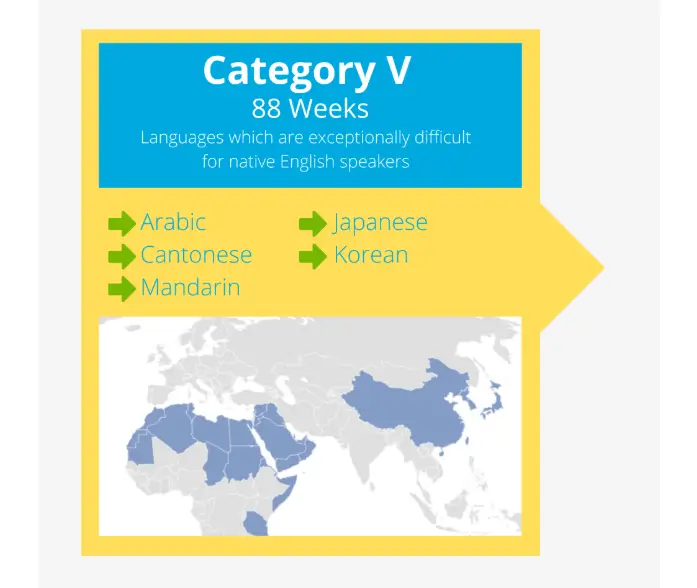
The U.S. Foreign Service Institute trains diplomats in over 70 languages and publishes hour-to-proficiency estimates built on decades of full-time classroom instruction. Mandarin sits alongside Arabic, Japanese, and Korean in the hardest category.
| Language | FSI category | Estimated hours | Approx. multiple vs Spanish |
|---|---|---|---|
| Spanish / French / Italian | Category I | 600–750 h | Baseline |
| German / Indonesian | Category II | ~900 h | ~1.3x |
| Russian / Hebrew / Thai | Category III | ~1,100 h | ~1.6x |
| Mandarin Chinese | Category IV | ~2,200 h | ~3–4x |
| Arabic / Japanese / Korean | Category IV | ~2,200 h | ~3–4x |
Two caveats worth keeping in mind before you use this number. First, “professional working proficiency” (ILR Level 3) means a diplomat can use Mandarin in formal written and spoken contexts with minimal support. Basic conversation comes earlier. Second, the FSI figures assume full-time, 40-hour-per-week instruction with motivated adult learners in a structured program. Your actual pace will differ.
A simple way to translate the 2,200-hour figure into everyday terms:
| Weekly study hours | Hours per year | Years to ~2,200 h |
|---|---|---|
| 5 h/week | 260 h/year | ~8.5 years |
| 10 h/week | 520 h/year | ~4.2 years |
| 15 h/week | 780 h/year | ~2.8 years |
| 20 h/week | 1,040 h/year | ~2.1 years |
| 40 h/week (full-time) | 2,080 h/year | ~1.1 years |
These figures reflect the FSI professional-proficiency endpoint only. Most learners hit meaningful, usable milestones long before 2,200 hours.
The 5 Variables That Shape Your Timeline
Two learners can each log 1,000 hours of Mandarin study and end up in very different places. These five variables explain most of that gap.
1. Weekly study hours and consistency
The arithmetic is simple: more hours per week means fewer calendar years to any given milestone. What it can’t capture is consistency. Cramming 20 hours into one weekend is far less effective than 4 hours spread across five days. Spaced repetition works; bingeing does not.

2. Learning method and feedback quality
Tones and listening, the two hardest skills in Mandarin for English speakers, are also the two that self-study alone handles worst. Errors in tone production feel correct from the inside; you need an external reference to catch them. Learners in live, small-group classes with native teachers correcting in real time consistently outpace equivalent hours of app-based solo study in these areas. Method quality is arguably the single biggest variable on your timeline.
3. Your specific goal
“Learn Chinese” can mean a hundred different things. Ordering food in Shanghai is not the same as negotiating a business deal in Mandarin or reading a Chinese newspaper. Getting specific about what you actually want to do is the fastest way to shorten your timeline. Clarity about the goal is what makes every study hour count.

4. Prior language learning experience
If you’ve studied a tonal language before (Thai, Vietnamese, Cantonese), you already have tone-awareness that most learners spend months developing. Background in any logographic or character-based script also shortens the adjustment to 汉字 (hànzì), Chinese characters. And prior language study of any kind builds habits that carry over: how to memorise vocabulary efficiently, how to structure practice.
5. Definition of success
This is the variable most people skip. “I can have a slow conversation about familiar topics with a patient speaker” is not the same goal as “I can understand a native-speed TV drama without subtitles.” Both are legitimate. Neither can share a timeline.
A Goal-by-Goal Breakdown
The table below shows estimated study hours for five typical learning targets, at two common study paces. The numbers come from FSI data, HSK curriculum benchmarks, and practitioner estimates. They are ranges, not guarantees, and your results will vary based on the five variables above.
| Goal | Approx. total hours | At 10 h/week | At 5 h/week |
|---|---|---|---|
| Basic survival: greetings, numbers, ordering food | 100–200 h | ~3–5 months | ~6–10 months |
| Simple conversations on familiar topics | 400–700 h | ~10–17 months | ~20–27 months |
| HSK 4 level: handle most everyday situations | 1,000–1,200 h | ~2–2.5 years | ~4–5 years |
| HSK 6 level: advanced, near-professional | 2,000–2,500 h | ~4–5 years | ~8–10 years |
| FSI professional working proficiency | ~2,200 h (intensive, full-time) | ~4 years | ~8.5 years |
All figures assume consistent, structured study with meaningful speaking practice and feedback. Method quality, not hours alone, is the largest driver of variation within these ranges.
The most important row is the one that matches your actual goal. A lot of learners find they’re aiming for the HSK 4 range, not the 2,200-hour professional endpoint. That shift alone makes the timeline look a lot more realistic.
The HSK Framework as a Milestone Map
The HSK (Hànyǔ Shuǐpíng Kǎoshì) is China’s official Mandarin proficiency test. Its six levels offer a useful, internationally recognised milestone framework. The vocabulary and character counts below reflect the established HSK framework; note that a revised HSK system is being phased in internationally, with different level structures.
| level | vocabulary | characters | what you can do | Approx. study hours |
|---|---|---|---|---|
| HSK 1 | ~150 words | ~174 characters | Greet people, ask basic questions, introduce yourself | 150–200 h |
| HSK 2 | ~300 words | ~347 characters | Handle simple, routine tasks; understand slow, clear speech | 300–400 h |
| HSK 3 | ~600 words | ~617 characters | Communicate in most everyday situations while travelling | 600–800 h |
| HSK 4 | ~1,200 words | ~1,064 characters | Converse fluently with native speakers on a wide range of topics | 1,000–1,200 h |
| HSK 5 | ~2,500 words | ~1,685 characters | Read Chinese newspapers and magazines; watch most TV with some support | 1,500–2,000 h |
| HSK 6 | ~5,000 words | ~2,663 characters | Comprehend virtually anything in written or spoken form; near-professional | 2,000–2,500 h |
HSK 4 is widely seen as the point where you can handle most everyday conversations without too much difficulty. At 10 consistent study hours a week, that’s a realistic two-year target for most learners, though individual results vary.
For a full breakdown of how many characters you need to know at each level and for different real-world goals, see our Chinese characters guide.
How Long Does It Take to Become Fluent in Mandarin | What “Fluent” Actually Means
“Fluency” is the word that makes timelines almost meaningless without a definition attached. Here’s how it actually breaks down.
- Conversational fluency (familiar topics, patient speaker): Most learners reach this level somewhere in the 500 to 800-hour range, with consistent structured study and regular speaking practice. You can talk about your work, your interests, and your daily life in 普通话 (Pǔtōnghuà) without the conversation breaking down. Native speakers may slow down or simplify occasionally.
- Functional fluency (most everyday situations, most speakers): This aligns roughly with HSK 4. The commonly cited range is 1,000 to 1,200 hours. You can handle most real-world situations, follow Mandarin-speaking colleagues in a workplace, and catch the gist of native-speed conversation on familiar topics.
- Professional working fluency: The FSI’s 2,200-hour benchmark. You can operate effectively in Mandarin across professional, written, and formal contexts with minimal support.
- Native-like fluency: Beyond the FSI scale. Most adult learners never reach this level regardless of hours spent, and for most people who want to “learn Mandarin,” it’s not the target anyway.
The critical practical takeaway: if your goal is conversational fluency, your timeline is likely a quarter of the FSI figure, not 2,200 hours. Getting clear on your target before you start is the best way to avoid spending years pointed in the wrong direction.
Mistakes That Slow Down Your Timeline
- Mistake 1: Treating the FSI figure as your personal deadline. The 2,200-hour estimate is an institutional benchmark for diplomat-level proficiency under full-time training. Most learners need a fraction of that for their actual goal. Seeing 2,200 hours and giving up before starting is the most expensive mistake on this list.
- Mistake 2: Measuring time but not quality. Logging 500 hours of unfocused listening or low-level app repetition isn’t the same as 500 hours of deliberate practice with feedback. The question isn’t “how many hours have I studied?” but “how much of that time involved active production, correction, and review?”
- Mistake 3: Skipping speaking until your Mandarin is “ready.” There is no ready. The only way to develop speaking is to speak, collect errors, and correct them. Delaying it until grammar or vocabulary reaches some imaginary threshold costs real time. At Flexi Classes, learners speak from lesson one, with native teacher correction building accurate habits from the start.
- Mistake 4: Studying characters before you need them. If your goal is spoken Mandarin, every hour spent learning to write characters is an hour not spent on tones, vocabulary, or listening. Pinyin covers the phonetics of 普通话 (Pǔtōnghuà) entirely. Add characters when your goal requires reading, not before.
- Mistake 5: Inconsistency. A learner putting in 5 hours every week for two years will outperform someone who does 15 hours a week for two months and then stops. Language learning runs on spaced repetition and regular exposure. Regularity beats intensity almost every time.
Frequently Asked Questions (FAQ)
How long does it take to learn Chinese?
For professional working proficiency, the FSI estimates around 2,200 hours for English speakers in a full-time programme. For conversational ability in everyday situations, most estimates cluster around 500 to 1,200 hours depending on the level of fluency you are aiming for. The specific answer depends on your goal, weekly study hours, and learning method.
How long does it take to learn Mandarin for a beginner?
Most beginners can hold simple conversations on familiar topics after 400 to 700 hours of structured practice with regular speaking. At 10 hours per week, that range represents roughly 10 to 17 months. At 5 hours per week, roughly 20 to 27 months. These are estimates, not guarantees, and depend heavily on method and consistency.
How long does it take to become fluent in Mandarin?
That depends entirely on what you mean by fluent. Conversational ability in everyday situations is reachable in the range of 500 to 800 hours for most learners. Professional working proficiency, the FSI’s benchmark, is approximately 2,200 hours in an intensive full-time programme. “Fluent” is not one destination.
How many hours does it take to learn Chinese?
The FSI estimates 2,200 hours for professional proficiency for English speakers. Conversational milestones arrive earlier: roughly 150 to 200 hours for basic survival phrases, 1,000 to 1,200 hours for HSK 4 functional conversational ability. The right figure depends on your target level.
How long does it take to learn Mandarin Chinese at 1 hour a day?
At 7 hours per week (roughly 1 hour a day), you accumulate around 365 hours per year. To reach HSK 4 functional fluency, which most learners estimate at 1,000 to 1,200 hours, that pace puts the milestone at roughly 3 to 3.5 years with consistent, quality study. Basic conversational exchanges on familiar topics tend to emerge considerably earlier at that pace.
Is Chinese harder to learn than Japanese?
Both sit in the FSI’s hardest language tier at approximately 2,200 hours, but for different reasons. Japanese has three writing systems and a complex social register system. Chinese has one writing system but a four-tone system Japanese lacks. For a full comparison, see our Chinese vs Japanese vs Korean breakdown.
How long would it take to learn conversational Chinese?
Most learners describe reaching conversational ability on familiar topics, meaning you can carry a natural discussion with a patient speaker, somewhere in the 500 to 800 hour range. At 10 hours of study per week, that translates to roughly 1 to 1.5 years. Method quality, particularly access to live native-speaker feedback, significantly affects where you land within that range.
Can you learn Mandarin in a year?
Reaching basic conversational ability in a year is realistic for learners who study 10 or more hours per week with structured instruction and regular speaking practice. Reaching advanced or professional proficiency in a year is not realistic for most adult learners regardless of effort. The honest answer is that a year of serious study is a significant and meaningful foundation, not an endpoint.
Stop Estimating and Start Testing
The most accurate timeline for you isn’t in any table in this guide. It comes from your actual hours, your actual method, and your actual goal. The fastest way to find it: start studying with a native speaker and see how quickly things move.
Flexi Classes offers live Mandarin classes with native teachers in small groups of up to five. 60 minutes per session, flexible scheduling, and our 7-day free trial to start getting real hours and real feedback from day one. Your timeline starts when you do.