

 Spanish
 Italian
 French
 Russian
 Japanese
 Mandarin Simplified
 Mandarin Traditional
 Vietnamese
 Cantonese
 Shanghainese
 Taiwanese
How many Chinese characters exist? The full breakdown
Discover how many Chinese characters exist and how many you need for proficiency

So, how many Chinese characters exist?
The short answer: dictionaries have recorded anywhere from 47,035 (the classic Kangxi Dictionary) to over 106,000 (the modern Yitizi Zidian). In daily life, though, a well-educated adult uses around 3,500 to 4,000.
That gap between ‘recorded’ and ‘needed’ is exactly what this guide unpacks, from the big dictionary numbers down to the precise character counts for each HSK level.
How many Chinese characters have been recorded?
How did Chinese characters evolve?
What are the six types of Chinese characters?
Simplified vs. traditional characters
How many Chinese characters do you need to be fluent?
Character goals for each HSK level
How many characters do Chinese people learn at each stage?
How does the Chinese character count compare to Japanese?
How many characters should you learn per day?
How many Chinese characters have been recorded?
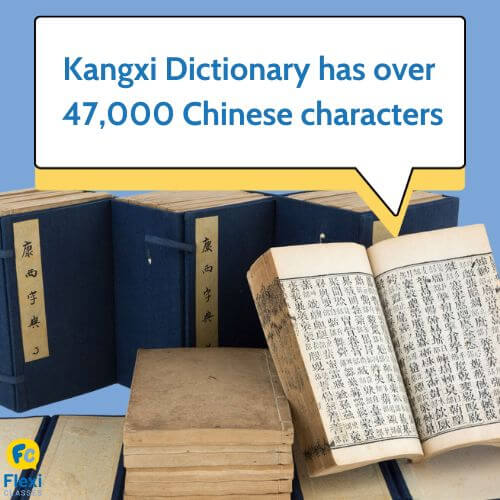
How many Chinese characters have ever been recorded? It depends on which dictionary you open.
| Dictionary | Year | Characters recorded |
|---|---|---|
| Kangxi Zidian (康熙字典) | 1716 | 47,035 |
| Hanyu Da Zidian (汉语大字典) | 1986-1994 | 54,678 |
| Zhonghua Zihai (中华字海) | 1994 | ~85,000 |
| Yitizi Zidian (异体字字典) | 2004 | ~106,230 |
Those numbers look intimidating, but they include thousands of archaic, regional, and variant forms that even native Chinese scholars rarely encounter. The 3,500 characters listed in China’s Table of General Standard Chinese Characters (通用规范汉字表, Tōngyòng Guīfàn Hànzì Biǎo, 2013) are what a modern educated adult is expected to know. That is your real target.
How did Chinese characters evolve?
Chinese characters have been developing for over 3,000 years. Here is the rough timeline every learner finds useful:
Oracle Bone Script (甲骨文, jiǎgǔwén), c. 1250 BCE. The earliest confirmed form of Chinese writing, carved onto animal bones and turtle shells for divination. Many characters were simple pictures of the things they described.
Bronze Inscriptions (金文, jīnwén), c. 1100-221 BCE. Characters cast into bronze vessels became slightly more stylised and began moving away from pure pictures toward abstract forms.
Small Seal Script (小篆, xiǎozhuàn), c. 221 BCE. When the Qin dynasty unified China, it standardised the writing system across the country. Small Seal Script was that standard: rounder, more regular, and the direct ancestor of every character you will learn today.
Clerical Script (隶书, lìshū), c. 200 BCE onward. Government clerks needed to write faster, so characters flattened out and straight brushstrokes replaced curves. This is the turning point where modern-looking characters begin to appear.
Regular Script (楷书, kǎishū), c. 200 CE onward. Still the dominant form today. The characters in your textbook, on your phone, and in every newspaper are Regular Script. When you learn to write Chinese, this is what you learn.
Knowing this timeline helps you understand why Chinese characters look the way they do, and why some still carry a faint picture of their original meaning inside them.
What are the six types of Chinese characters?
Not all Chinese characters were invented the same way. The classical system called 六书 (Liù Shū), literally ‘six scripts’, describes how characters were created. Knowing the categories makes learning new characters much easier, because you start to see the logic behind the shapes.
- Pictograms (象形, xiàngxíng). Characters that started as drawings of physical things. 山 (shān, mountain) looks like three peaks. 日 (rì, sun) is a circle with a dot. Around 4% of modern characters fall into this group.
- Indicatives (指事, zhǐshì). Abstract symbols that point to a concept. 上 (shàng, above) and 下 (xià, below) show position with a simple line. Rare, fewer than 1% of characters.
- Compound Ideograms (会意, huìyì). Two or more existing characters combined to suggest a new meaning. 明 (míng, bright) puts 日 (sun) next to 月 (moon). Together they make light.
- Phono-Semantic compounds (形声, xíngshēng). One part hints at meaning, the other hints at pronunciation. This is by far the largest category, around 80-90% of Chinese characters work this way. Once you recognise the components, you can make educated guesses at both the meaning and sound of unfamiliar characters.
- Transfer characters (转注, zhuǎnzhù). Characters that borrowed meaning from a related character over time. Linguists still debate exactly which characters belong here.
- Phonetic loans (假借, jiǎjiè). Characters borrowed purely for their sound, with their original meaning set aside. The modern use of 来 (lái) to mean ‘come’ began as a phonetic loan from a word that originally meant a type of wheat.
The practical takeaway: because most characters are phono-semantic compounds, learning common radicals (the meaning-hint components) is one of the highest-return study habits you can build early.
Simplified vs. traditional characters
Chinese characters come in two forms: simplified and traditional characters.
Simplified characters are used in mainland China. They were introduced in the 1950s to improve literacy rates.
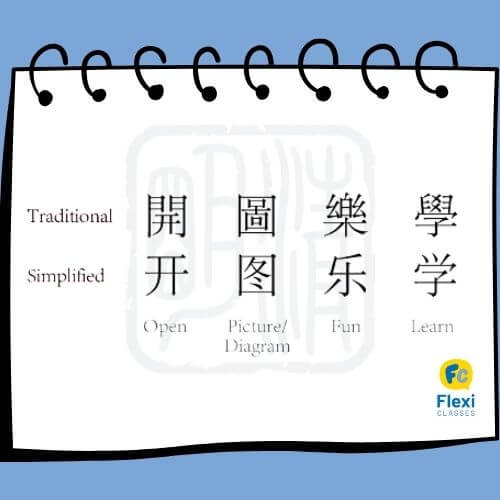
These characters have fewer strokes than traditional characters and are quicker to learn and write. Hence, more people who were uneducated could learn how to read and write.
On the other hand, traditional characters are the legacy of the ancient Chinese language that hasn’t been modified. They are still widely used in cities like Taipei and Hong Kong. Although more complicated, they are like art pieces that carry calligraphy’s history and intricate beauty.
Traditional Chinese has more unique characters than simplified Chinese. Some traditional characters were merged into a single simplified character.
In terms of recorded characters, both systems draw on the same historical pool of tens of thousands. The Kangxi Dictionary (47,035 characters) predates the simplified/traditional split and covers both. What changed in 1956 was not the total inventory but which forms became the official standard: Mainland China adopted 2,235 simplified forms in the first reform wave, eventually standardising around 2,700 simplified characters against their traditional counterparts. The remaining characters in both systems are largely identical.
While there are thousands of unique characters between the two systems, many simplified characters are derived from traditional ones, so once you know one system, learning the other becomes easier.

SuperTest HSK (formerly HSK Online) Review & Guide
Today we’re going to do a HSK Online review. It’s an app dedicated to helping you learn everything related to the HSK Exam and passing it.
How many Chinese characters do you need to be fluent?
You do not need to know thousands of characters to get by. The numbers are more manageable than most people expect.
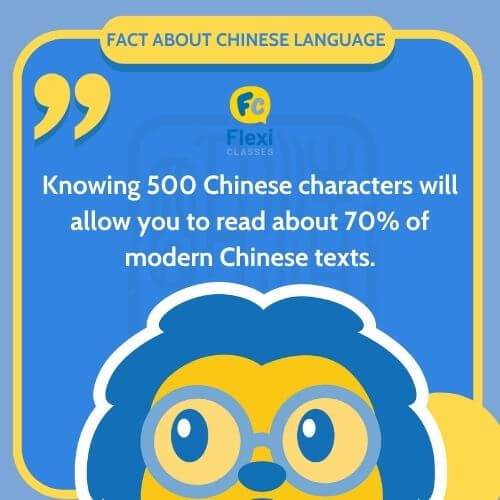
500 characters cover roughly 70% of modern Chinese text. You can follow simple messages, read basic signs, and handle everyday written communication.
For travel, reading menus in Beijing, navigating subway signs in Shanghai, or deciphering a hotel check-in form in Chengdu, around 500 to 800 characters is a practical starting point. That covers the most common signs, food words, transport vocabulary, and basic numbers.
1,000 characters gets you to around 90% comprehension of written and spoken Chinese. At this level you can hold conversations and follow most news stories.
For everyday life as a resident, 1,000 to 2,000 characters will have you covered across most daily interactions: shopping, messaging, reading short news headlines, and following a recipe.
2,500 to 3,500 characters is the range where most learners describe feeling genuinely fluent in reading: newspapers, novels, and social media included. This aligns with China’s national literacy standard for middle-school graduates.
Fluency in speaking arrives before fluency in reading for most people, so do not wait until you ‘know enough characters’ to start practising out loud. The two skills build each other.
Character goals for each HSK level
The HSK (Hànyǔ Shuǐpíng Kǎoshì), or Chinese Proficiency Test, is the standard measure of Chinese proficiency for non-native speakers. Each level tests a certain number of words and characters. It’s like your roadmap to mastering Chinese.
Now let’s take a look at each goal for you to conquer:
HSK 1: 150 words (about 174 characters)
HSK 2: 300 words (around 347 characters)
HSK 3: 600 words (about 617 characters)
HSK 4: 1,200 words (around 1,073 characters)
HSK 5: 2,500 words (approximately 1,700 characters)
HSK 6: Over 5,000 words (covers roughly 2,500+ characters)
The higher the level, the more characters and vocabulary you’re expected to know. By the time you reach HSK 5 or 6, you’re not just reading. You’ll be flowing through newspapers, academic articles, and classic literature like a local.
Want to know which level of HSK you are in? Try the HSK placement tests here!
How many characters do Chinese people learn at each stage?
HSK levels tell you where you stand as a learner. But how does that compare to a native speaker at school? Here is a rough guide based on Chinese national curriculum expectations:
| Stage | Approximate characters known |
|---|---|
| After primary school (age 12) | ~2,500 |
| After middle school (age 15) | ~3,500 |
| After high school (age 18) | ~4,500-5,000 |
| University graduate | ~6,000-7,000 |
| Professional writer or editor | 8,000+ |
| Language scholar | 10,000+ |
The 3,500 figure is especially significant: it is the number mandated by China’s Table of General Standard Chinese Characters (通用规范汉字表) as the literacy baseline for a middle-school graduate. If you reach 3,500 characters, you can read a Chinese newspaper with very few gaps.
For most learners, that middle-school graduate level is the practical fluency target, and it is absolutely achievable with consistent study.
How does the Chinese character count compare to Japanese?
Japanese uses a subset of Chinese characters called kanji (漢字, hànzì in Chinese). So the two systems are related, but the numbers are very different.
Japanese has around 50,000 kanji recorded in major dictionaries, but the official Joyo kanji list, the characters taught in Japanese schools and used in newspapers, contains 2,136. A well-educated Japanese adult typically knows around 3,000-4,000 kanji in total.
In Chinese, the equivalent benchmark is the 3,500 General Standard Characters, though educated adults typically recognise 5,000-7,000 in reading.
The key difference is not just count: it is that Japanese uses kanji alongside two phonetic syllabaries (hiragana and katakana), while Chinese writing is entirely character-based. Neither is objectively easier. They are different puzzles. You can read more about what makes Mandarin challenging (and what makes it surprisingly learnable) in our guide to tones, characters, and the Mandarin writing system.
How many characters should you learn per day?
This is one of the most practical questions learners ask, and the answer is more encouraging than you might think.
If you learn 10 new characters a day, you will hit the 3,500 literacy benchmark in about a year. Five characters a day gets you there in roughly two years. Even three a day, less than five minutes of focused review, adds up to over 1,000 characters in a year.
The catch is not the learning; it is the forgetting. Spaced repetition (reviewing characters at increasing intervals) is the method that makes the numbers stick. Pairing that review habit with live conversation practice is what moves characters from ‘recognised on a flashcard’ to ‘understood mid-sentence at full speed’, which is a different skill entirely.
If you want to accelerate that second part, practising with a native teacher in live classes is one of the most efficient routes. You can try a free Flexi Classes trial and see how quickly reading clicks when you are using characters in real conversation.
Fun facts about Chinese characters
Funfact #1
Here are a few interesting facts about Chinese characters: The most complex Chinese character is biáng, with 58 strokes! It describes a type of noodle called biángbiáng 面 (miàn) from Shaanxi province. It got the name because the noodles are al dente, so it makes that sound biáng when you make it.

You would think HSK 1 is easy. Guess what? HSK 1 characters make up around 80% of everyday conversations in Chinese. So that will set you off as a great start.
Funfact #2
Some characters have multiple pronunciations depending on the context.
Take 行 for example. Pronounced as ‘xíng,‘ it means ‘to walk.’ But say it as ‘háng,’ and suddenly you’re talking about a profession or a row of things. One character, two completely different worlds depending on how you say it. That is Chinese in a nutshell.

Some Chinese characters have remained unchanged for thousands of years. Think about it. When you see and write it, you’re like having a conversation with people across millennia.
Many Chinese characters started as images from the oracle bone script. People draw what they see from nature and turn it into a symbol to communicate.
For example, 山 (shān) means ‘mountain’. Its original character looks like a mountain with three peaks. It’s like an emoji but with a few thousand years of history!
What is the most difficulty for you to learn Chinese character? Share with us here!

HSK 1 Placement Test
TEST YOUR HSK 1 VOCABULARY, GRAMMAR AND READING SKILLS Ready to dip your toes into Mandarin? Our free HSK 1 placement test is the easiest way to find out where your Chinese journey begins. This quick quiz will assess your…
FAQ
How many Chinese characters do I need to know to be fluent?
To be fluent, you’ll need to know only around 2,500 to 3,000 characters to understand most modern texts and have daily conversations.
What’s the difference between simplified and traditional characters?
Simplified characters have fewer strokes and are mainly used in mainland China, while traditional characters are used in Taiwan, Hong Kong, and Macau.
How many characters are required to pass HSK 5?
For HSK 5, you need to know around 1,700 characters and 2,500 words.
Is learning traditional characters harder than simplified ones?
Traditional characters have more strokes, which can make them harder to write, but once you know one system, learning the other isn’t too difficult.
Can I communicate in Chinese if I only know 1,000 characters?
Yes! Knowing 1,000 characters can help you understand about 90% of daily conversations and texts.
What is the hardest Chinese character?
The most famous candidate is 𰻞𰻞面 (biángbiáng miàn), the character biáng used for a type of wide noodle from Shaanxi province. The most complex variant has 58 strokes, making it the most stroke-heavy character in active (if informal) use. For characters in standard dictionaries, 龘 (dá, meaning ‘the appearance of a dragon walking’) and 靐 (bìng, an archaic word for thunder) both clock in at over 30 strokes.
How do you write the numbers 1 to 10 in Chinese?
Here they are in simplified characters with pinyin: 一 (yī, 1), 二 (èr, 2), 三 (sān, 3), 四 (sì, 4), 五 (wǔ, 5), 六 (liù, 6), 七 (qī, 7), 八 (bā, 8), 九 (jiǔ, 9), 十 (shí, 10). The numbers 1, 2, and 3 are among the simplest characters to write, literally one, two, and three horizontal strokes.
How many Chinese characters do you need to be fluent?
For comfortable reading fluency, aim for 3,500 characters, the national standard for educated adults in mainland China. For conversational fluency, speaking practice matters more than character count; many learners speak confidently at the 1,000-character level.
Want more from Flexi Classes?
Reading apps like Maayot are great for daily practice. If you also want to speak with a native teacher, you can try our live Mandarin classes with a 7-day free trial.
We also offer immersive Chinese courses in China. You can learn more about those here.
Sign up below and become part of our ever-growing community.
⭐ Download our free ebook, your starter pack of essential Mandarin learning resources!