

 Spanish
 Italian
 French
 Russian
 Japanese
 Korean
 Mandarin Simplified
 Mandarin Traditional
 Vietnamese
 Cantonese
 Shanghainese
 Taiwanese
Coming of Age Day in Japan: Celebrating the Journey to Adulthood
Understanding the History and Culture of Coming of Age Day in Japan
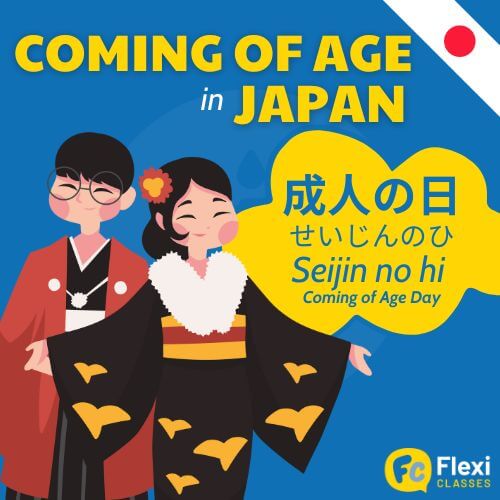
One of the most important of these holidays in Japan is “Coming of Age Day,” which falls on the second Monday in January.
This day is observed as a day for young people who have reached the age of 20 to become adults and renew their commitment to contribute to society.
For foreigners, it may be difficult to understand what this day means and how it is celebrated.
This article details the history and cultural background of Coming of Age Day and its significance in the modern world.
Coming of Age Day in Japan || History of Coming of Age Day
Coming of Age Day in Japan || Significance of Coming-of-Age Day
Coming of Age Day in Japan || Coming of Age Day Issues
Coming of Age Day in Japan || Historical Coming of Age Ceremony
Coming of Age Day in Japan || FAQs
Coming of Age Day in Japan || History of Coming of Age Day
The origin of Coming of Age Day dates back to 1948, when January 15 was designated as Coming of Age Day in accordance with the Law Concerning National Holidays enacted in 1948.
Initially, it was intended as a day to commemorate young men and women who had reached the age of 20 and to celebrate their independence and responsibility as adults.
However, with the introduction of the “Happy Monday” system in 2000, Coming of Age Day was moved to the second Monday in January. With the introduction of this system, Coming of Age Day became a three-day weekend, allowing many people the opportunity to spend the day with family and friends.

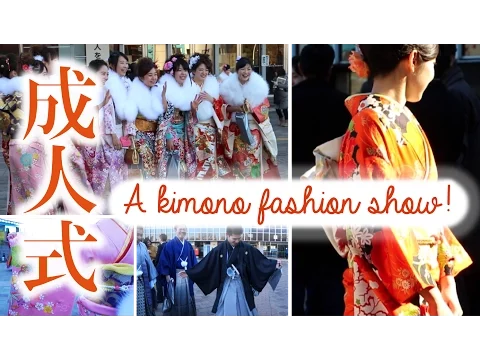
The biggest event of Coming of Age Day is the 成人式 せいじんしき Coming of Age Ceremony held in each municipality. The Coming-of-Age Ceremony is a ceremony where young people who have reached the age of 20 come together to promote their awareness of the responsibilities of adulthood.
At this ceremony, mayors and representatives of local governments offer words of encouragement to the young people and provide an opportunity for them to reaffirm their responsibilities as members of society.
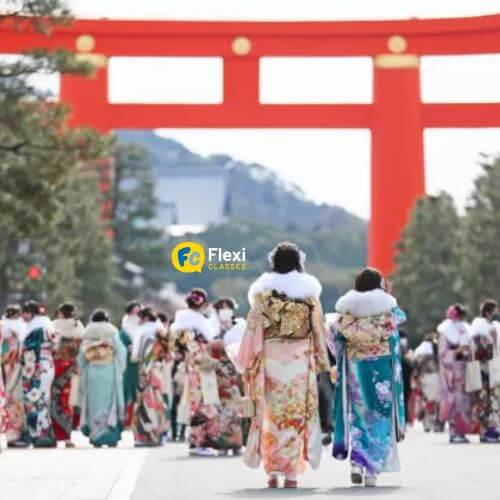
A characteristic sight at coming-of-age ceremonies is that men wear suits or hakama, while women wear traditional kimono called furisode. Furisode, in particular, are often rented or purchased for the coming-of-age ceremony and feature gorgeous, colorful designs.
On the day of the Coming-of-Age Ceremony, young people dressed in such attire can be seen at venues all over Japan.
Coming of Age Day in Japan || Significance of Coming-of-Age Day
Coming of Age Day is the day when young people who have reached the milestone of 20 years of age are legally and socially recognized as adults. As a matter of fact, in 2022, legal adulthood in Japan was lowered to 18 years of age.
In practice, at the age of 18, a person can enter into contracts without parental consent and vote.
However, coming-of-age ceremonies are still often held for 20-year-olds. The reason for this is that 20 has always been considered the age of adulthood, and the purchase and consumption of alcohol and tobacco is still prohibited under the age of 20.

Happy Birthday in Japanese 🎁 A Complete Guide
We learn how to say Happy Birthday in Japanese and teach you some important cultural points about birthday in Japan including the important birthdays!
Coming of Age Day in Japan || Coming of Age Day Issues
In the 2000s, the increase in the number of young people who became violent at coming-of-age ceremonies became an issue.
Since drinking and smoking are allowed at age 20, young people were seen smoking openly at these ceremonies, drinking large quantities of alcohol, and acting in ways that went far beyond the original purpose of the ceremony, which was frequently reported in the media.
Today, such wild coming-of-age ceremonies have become less common, but there are still some areas where people dress flamboyantly for the coming-of-age ceremony and it has become a kind of cosplay event.

This is a manifestation of the desire for self-expression and approval that is unique to young people, and is not in line with the original purpose of the coming-of-age ceremony.
Many people wear hakama or furisode (traditional Japanese kimono) for coming-of-age ceremonies, but instead of traditional attire, they dress in flashy, modified, glittering outfits, much like the biker gangs of the past.
Because of this, an increasing number of serious young people choose not to participate in coming-of-age ceremonies.
Since coming-of-age ceremonies are sponsored by local governments and are funded by taxes, this also creates criticism of taxpayer-funded coming-of-age ceremonies, which are not well attended. For this reason, some municipalities are taking initiatives such as holding the ceremony online.
Coming of Age Day in Japan || Historical Coming of Age Ceremony
One of the reasons for the importance placed on the Coming-of-Age Ceremony is the custom of 元服 げんぷく Gempuku.
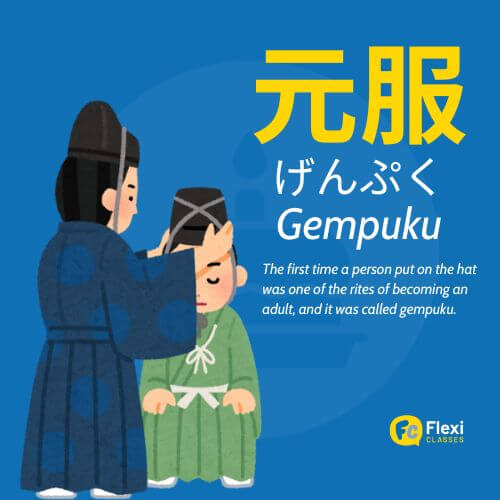
The Gempuku ceremony is said to have started in the Nara period (710-794), and was a rite of passage whereby a person’s hair was cut and was given a crown at the age of 12 to 15. This was a rite of passage that signified that the person had left childhood and joined the ranks of adults.
In paintings depicting Japanese royalty and aristocrats, they all wear crow-shaped hats. The first time a person put on the hat was one of the rites of becoming an adult, and it was called gempuku.
This rite of coming-of-age ceremony, performed by samurai and court nobles alike, was one of the most widely practiced rites of passage until it was abolished in the Meiji era (1868-1912).
This tradition is now practiced as the Coming of Age Ceremony, and the ceremony has gained a certain level of interest and respect in Japan.Therefore, young people who act out at the coming-of-age ceremony are greatly disliked because they ruin the significance of the ceremony.
In Japanese society, which places great importance on social order and the order of the elderly and the young, becoming an adult means having greater freedom of action, but also accepting the responsibilities that go along with that freedom.
Coming of Age Day is one of the most important national holidays in Japan and a major milestone in the lives of young people who have reached the age of 20. Through the coming-of-age ceremony, young people become aware of their responsibilities as adults and renew their commitment to their future lives.
In recent years, there has been ongoing debate over the format and significance of the coming-of-age ceremony, but the fact remains that Coming-of-Age Day remains a special day for young people.
Thus, Coming of Age Day is a cherished part of Japanese culture, and for foreigners, it is an important element in understanding Japanese society and culture. We hope that through Coming of Age Day, people will gain a deeper understanding of Japanese traditions and the process of young people becoming adults.

The Kimono Through Time || Everything You Need to Know about this Japanese Icon
From Kimono to Couture: The Evolution of Japanese Fashion PLUS Modern Japanese Street Fashion No matter how familiar you are with Japanese culture, you’ve probably heard of the Kimono. Kimono: 着物 (きもの) But how much do you know about…
How old are you? Do you want to join a Coming of Age Ceremony? Share your thoughts here!
Coming of Age Day in Japan || FAQs
When is Coming of Age Day in Japan?
Formerly January 15, it is now the second Monday in January.
What is the age of adulthood in Japan?
The legal age of majority is 18, but for a long time it was 20. Smoking and drinking are legal at age 20, and coming-of-age ceremonies seem to be held for people who are 20 years old.
What is the coming-of-age ceremony?
Coming-of-Age Ceremony is a ceremony held to encourage young people who have turned 20 years old to become adults.
Who will hold the coming-of-age ceremony?
Most are held by the local government of each region and are usually addressed by the head of that municipality.
What are the problems of coming-of-age ceremony?
It is the increase in the number of young people who act out of control and behave roughly. A few years ago, this was particularly bad and caused problems, such as an increase in the number of people who did not participate in the coming-of-age ceremony.
Want More From LTL?
WANT TO LEARN JAPANESE? Check out our online Japanese courses here.
We offer a 7-day free trial to all new students where you can study 24/7.
What about studying Japanese in Japan instead? We’ve got your back. Our Japanese courses in Tokyo can either be taken in small groups of no more than 5 students or individually for a more tailored experience.
We even offer incredible homestay experiences in Tokyo as well.
Come and be a part of this amazing community.