

 Spanish
 Italian
 French
 Russian
 Japanese
 Korean
 Mandarin Simplified
 Mandarin Traditional
 Vietnamese
 Cantonese
 Shanghainese
 Taiwanese
New Year Customs in Japan: Everything You Need to Know
Understanding Customs of Japanese New Year

The New Year in Japan is an important occasion to renew one’s spirit and confirm one’s hopes and expectations for the year ahead. The new year is welcomed with customs unique to Japan.
Understanding these customs is crucial to a deeper understanding of Japanese culture as well as the Japanese language.
There is a common notion that when the year changes, many things change as well. This may be due to the custom of settling daily payment debts and credits together at the end of the year in the past.
In Japan, people still scramble at the end of the year to clean their houses and finish various unfinished tasks in preparation for the New Year.
In Japan, the month of December is called 師走 しわす shiwasu, which means the master runs, where 師 means master and 走 means to run, meaning that one is very busy.
The reason one is so busy is, in part, due to the prevailing notion that everything must be completed before the new year can begin.
This article introduces some of the major Japanese New Year customs.
Japanese New Year || Hatsumoude
Japanese New Year || Kakizome
Japanese New Year || Osechi
Japanese New Year || Otoshidama
Japanese New Year || Kadomatsu
Japanese New Year || Kagamimochi
Japanese New Year || FAQs
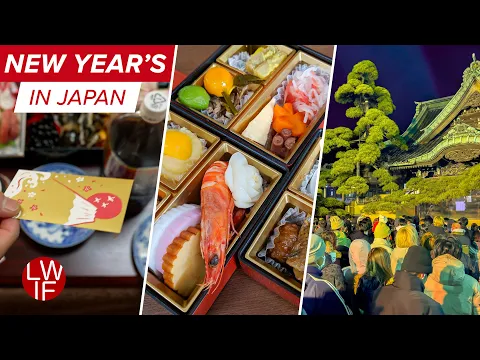
Japanese New Year || Hatsumoude
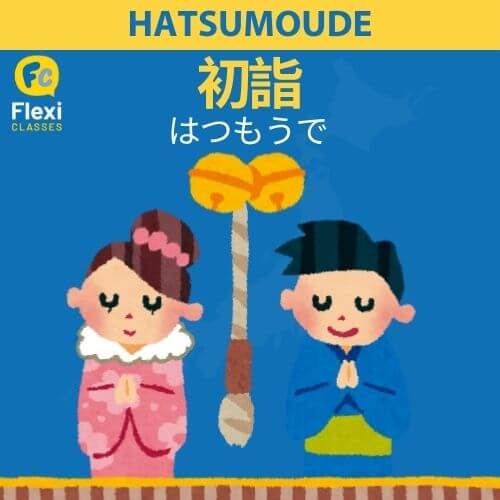
The first visit to a shrine after the new year is called 初詣 はつもうで Hatsumoude; some people go at midnight on December 31, just after the date change, while others go during the first three days of the year. Some people go to smaller, local shrines because the famous shrines can be very crowded with many people.
During Hatsumoude, people usually pray for good health and success in the coming year and purchase an おまもり omamori – good luck charm for the year. It is also customary to dedicate a 絵馬 えま ema, a wooden plaque with a horse on it, on which wishes are written. Drawing fortunes おみくじ omikuji is also common.
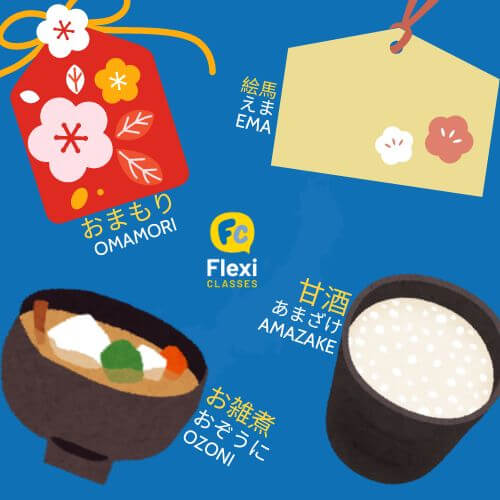
甘酒 あまざけ Amazake and お雑煮 おぞうに ozoni are sometimes sold at shrines for Hatsumoude.
Amazake is a fermented beverage made from rice and rice malt, some alcoholic and some non-alcoholic. Amazake, which is mentioned in the “Chronicles of Japan,” was served at various ceremonies at shrines in ancient times, but nowadays it is usually sold only during the New Year.
Ozoni is a type of soup in which various vegetables and fish are stewed. It is made according to various recipes depending on the region, so you can enjoy the unique ozoni of each place.
Japanese New Year || Kakizome
New Year’s Day is also marked by 書き初め かきぞめ kakizome, or the first writing of the New Year. People write calligraphy to express their hopes for the new year and words of good fortune.
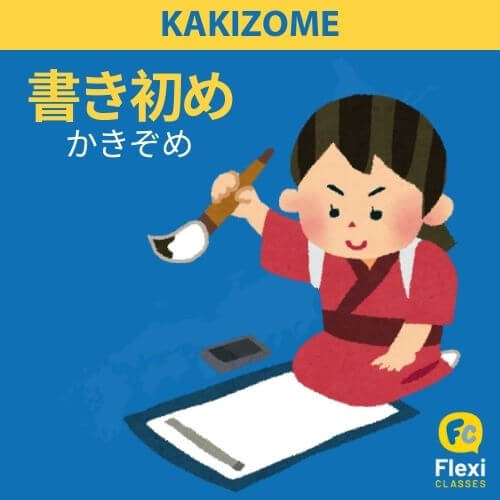
In elementary and junior high schools, kakizome of the year is often assigned as a winter vacation project, and prizes are given to the best works, which are sometimes sent to various competitions.
Kakizome began as a custom of the nobility in the Heian period (794-1185).
During the Edo period (1603-1867), education spread to the general public, and it is said that common people also began to write kakizome at the beginning of the year.
Townsend Harris, who came to Japan at the end of the Edo period to negotiate the opening of ports with the shogunate, wrote in his diary that he was impressed by calligraphy written with paper and brush. Once you learn Japanese, it will be interesting to try writing Japanese with paper and brush!
How to Say Happy New Year in Japanese (+ Why Context Is Key)
Greetings in Japanese are very important and often carry hidden meanings; Happy New Year in Japanese is no exception to this rule!
Japanese New Year || Osechi
The dishes specially prepared for New Year’s are called おせち osechi. Osechi has its own standard ingredients, and each has its own meaning:
|
エビ
ebi | Shrimp |
| 数の子 かずのこ kazunoko | Herring roe |
|
ゴボウ
gobou | Burdock |
| 黒豆 くろまめ kuromame | black soybean |
| 鯛 たい tai | sea bream |

Shrimps have a bent waist. Therefore, it is a prayer for longevity that you may live long until your waist bends.
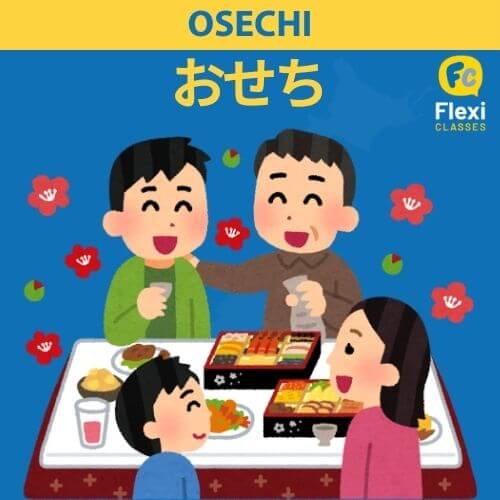
Herring roe is in Japanese called 数の子 かずのこ Kazunoko, meaning “many children” and thus is associated with a prayer for the prosperity of one’s offsprings.
Burdock is a root vegetable, and it is a prayer for good health because of its roots deep in the ground.
Black soybeans are called 黒豆 くろまめ kuromame in Japanese. The Japanese word for working hard is まめ mame, so we pray for good health at work in honor of this word.
Sea bream is also called tai in Japanese, and since めでたい medetai is the Japanese word for auspicious, it is wished for good fortune. Thus, many plays on words are used for good luck in Japanese.
Japanese New Year || Otoshidama
At New Year’s, it is common for relatives to get together.

At such gatherings, it is common for the elders among the relatives to give allowance money to the children, which is called お年玉 おとしだま otoshidama. Many children look forward to this.
Originally, it was not the custom to give money to children, but to dedicate round rice cakes to local shrines.
This rice cake was called tama, which means soul 魂 たましい tamashii, and is said to represent the spiritual power of the local gods.
Initially, these rice cakes were offered to the children to eat after the dedication, but the custom gradually changed to giving money to the children.
Visiting an Onsen in Japan // Which Onsen & What Should I Know
Visiting an onsen in Japan is an absolute must. Onsens are the natural hot springs in Japan and a big part of Japanese culture but what should you know?
Japanese New Year || Kadomatsu
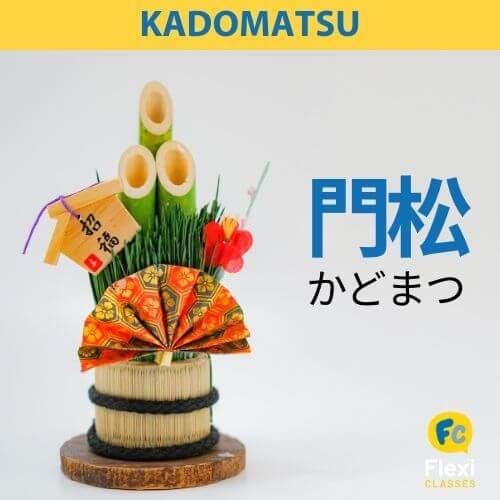
On New Year’s Day, a kadomatsu 門松 かどまつ (a pine tree) is decorated in front of the house. Pine trees are considered to be closely associated with the gods in Japan and are decorated in front of the house to welcome them.
In the Muromachi period (1333-1573), pine trees were combined with bamboo, and the form of the kadomatsu became the one we see today, with pine trees decorating the perimeter of a bamboo stand.
Japanese New Year || Kagamimochi
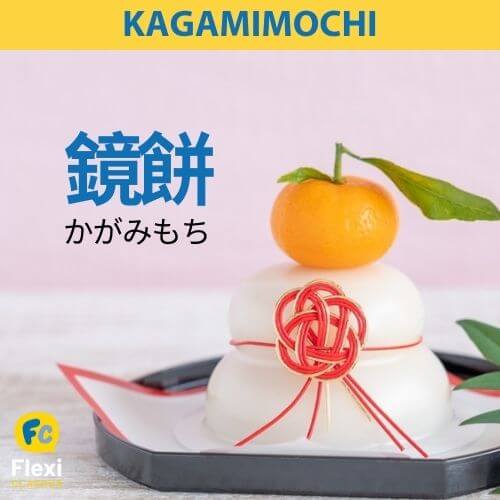
Inside the house, Kagamimochi 鏡餅 かがみもち , a pyramid of rice cakes 餅 もち mochi, is decorated.
Since ancient times, Kagami 鏡 has been used in rituals as a sacred vessel in which the gods dwell. People think of mochi as kagami and they will share their blessings with the gods by eating the mochi.
As we have seen above, the customs of the New Year are closely tied to Japanese culture, and it is during the Japanese New Year that we can feel that these customs are still alive and well in our daily lives. It would be interesting to compare the New Year’s customs of your home country with those of Japan!
Which one above is your favorite New Year custom in Japan? Share with us in the comments!
Japanese New Year || FAQs
How do you celebrate the New Year in Japan?
Kadomatsu and Kagamimochi are decorated, Osechi is prepared and people go to shrines for Hatsumoude.
What is Hatsumoude?
It is the first visit to the shrine in a year. We pray for health and success in the year ahead.
Why are there certain ingredients for Osechi?
This is because each ingredient has its own meaning. Shrimp, for example, is a prayer to live long until one’s waist bends like a shrimp.
What is Kakizome?
Kakizome is the first writing of the year with a brush. People write down their aspirations for the year and words of good fortune.
Why do you display Kagamimochi at New Year’s?
This is because it used to be believed that the gods would come to this mochi. After decorating it for a while, the mochi is eaten to receive the blessings of the gods.