
 Spanish
 Italian
 French
 Russian
 Japanese
 Mandarin Simplified
 Mandarin Traditional
 Vietnamese
 Cantonese
 Shanghainese
 Taiwanese
TOPIK Test: Overview, Levels, and Study Tips
Master the TOPIK Test: A Complete Guide to Levels and Tips
Are you learning Korean and want to gauge your proficiency? The Test of Proficiency in Korean (TOPIK) is a must-consider milestone. It’s an internationally recognised exam created to evaluate the Korean language skills of non-native speakers.
한국어능력시험 (han-guk-eo-neung-ryuk-si-hum) – Test of Proficency in Korean
한국어
Korean language능력
Ability시험
testWhether you’re learning Korean for work, studies, or personal development, TOPIK holds significant value as it can unlock educational and career opportunities in South Korea and beyond.
In this blog post, we’ll delve into what the TOPIK test entails, covering its structure, different levels, and study tips.
TOPIK TEST | What is the TOPIK Test
TOPIK TEST | How to Take the TOPIK Test
TOPIK TEST | Types of TOPIK Test
TOPIK TEST | TOPIK Test Structure
TOPIK TEST | Why Take the TOPIK Test?
TOPIK TEST | Practice Quiz
TOPIK TEST | FAQ
TOPIK TEST | What is the TOPIK Test
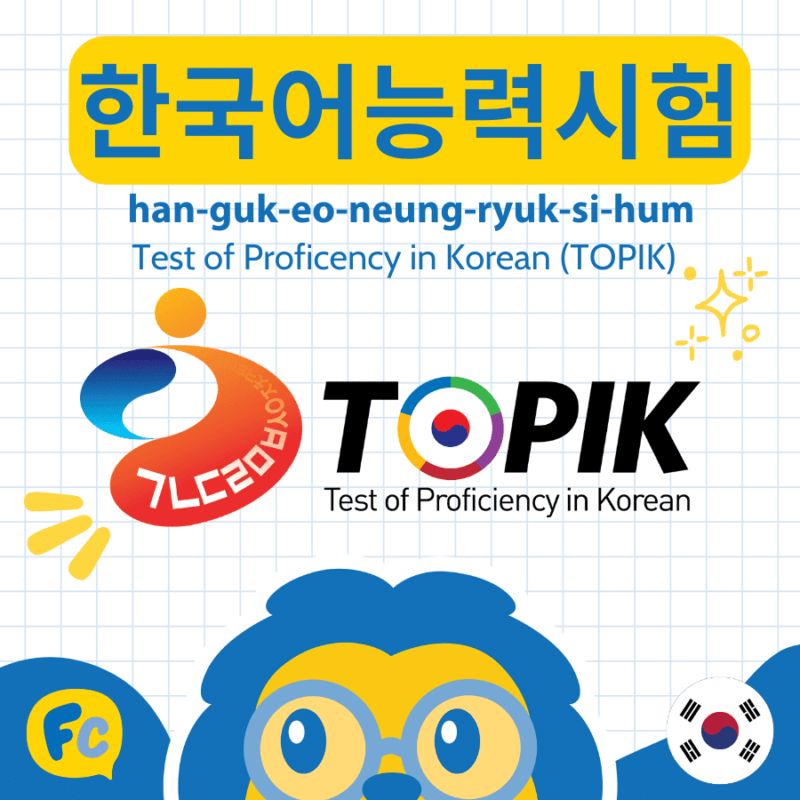
The TOPIK was first introduced in 1997 by the National Institute for International Education (NIIED) under South Korea’s Ministry of Education.
It is designed to measure proficiency in listening, reading, and writing, and it is primarily aimed at non-native speakers, including foreigners, overseas Koreans, and immigrants.
TOPIK TEST | How to Take the TOPIK Test
If you’re in Korea, registering for the TOPIK Test is easy! Just visit www.topik.go.kr and complete the online registration.
The fee is KRW 35,000 for TOPIK I (level 1-2) and KRW 40,000 for TOPIK II (level 3-6).
For those in other countries, you can register for the TOPIK test at Korean Embassies, 한국문화원 (han-guk-mun-hwa-won) – Korean Culture Centres, or affiliate institutes.
You can take the TOPIK test six times a year.

In Korea, it’s held in January, May, and November, while in both Korea and overseas, it’s held in April, July, and October.
In many countries, the TOPIK I test is in the morning and the TOPIK II test is in the afternoon. This means you can take both tests on the same day if you prefer.
For more information on TOPIK, you can visit their official website at www.topik.go.kr.
6 Important Korean Proverbs to Know for Daily Life
Korean proverbs is one of the best way to get familiar to the country’s culture and history. Lots of them are about food, but who is surprised about that?
TOPIK TEST | Types of TOPIK Test
The TOPIK test is divided into two main categories:
| TOPIK I | TOPIK II |
| Basic level proficiency (for beginners) | Intermediate and advanced level proficiency (for intermediate and advanced learners) |
초급
cho-geop
Beginner level
중급
joong-geop
Intermediate level
고급
go-geop
Advanced level
TOPIK TEST | Test Structure
The TOPIK test has two levels: TOPIK-I and TOPIK-II.
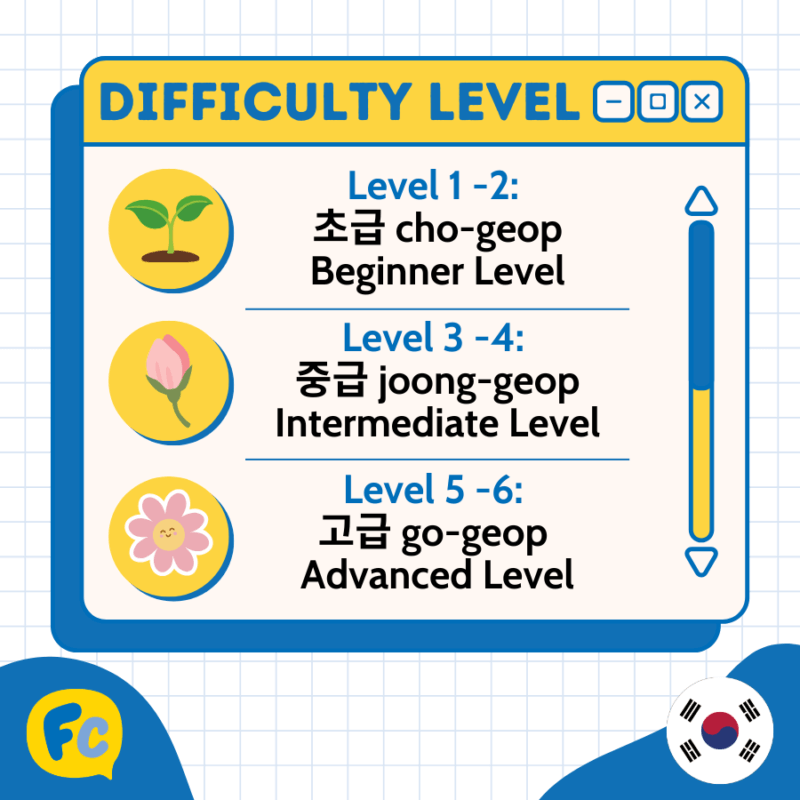
TOPIK-I, which is the beginner level, is divided into sublevels 1 and 2, while TOPIK-II, the Intermediate-Advanced level, consists of sublevels 3, 4, 5, and 6.
Test takers receive a level between 1 and 6 based on their total score on the test.
The breakdown of the levels is as follows:
Levels 1 and 2: Beginner Level
Levels 3 and 4: Intermediate Level
Levels 5 and 6: Advanced Level
TOPIK-I (Level 1-2) consists of two sections: Reading and Listening.
TOPIK II (Level 3-6), the combined Intermediate-Advanced test, includes three sections: Reading, Listening, and Writing.
Each section is graded out of 100 points, with a possible total of 200 points for the Beginner level and 300 points for the Intermediate-Advanced level. The test covers composition, listening, and multiple-choice sections.
The test is divided into two 90-minute sessions with a 30-minute break in between:
– The first session assesses vocabulary, grammar, and writing
– The second session evaluates listening and reading.
TOPIK I (Levels 1 and 2)
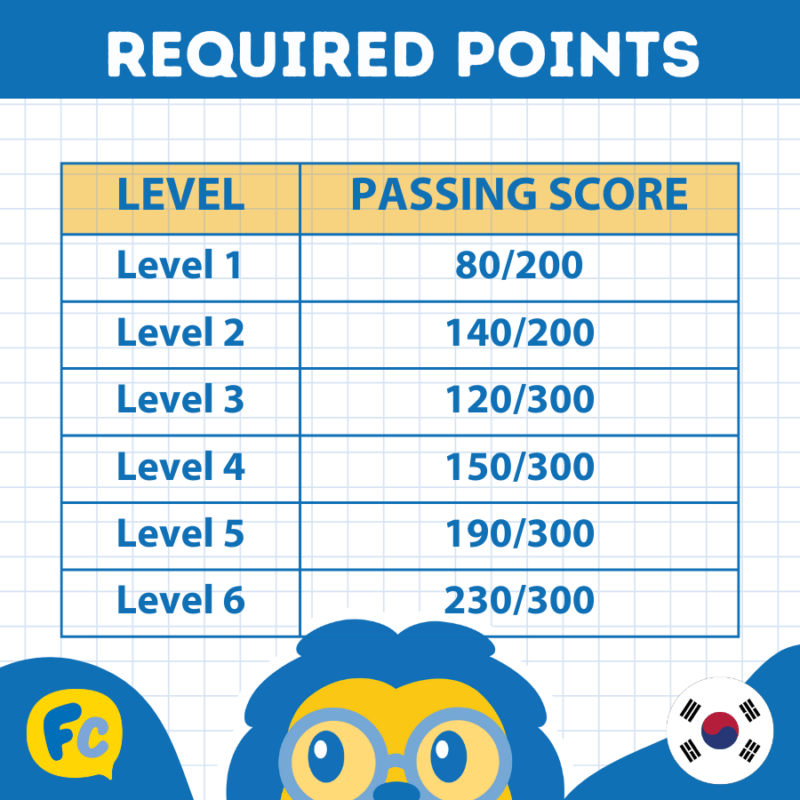
| Level 1 | This is the basic beginner level, suitable for learners who are just starting their Korean language journey. Achieving this level shows that the test taker can understand and use simple phrases related to everyday life, such as introducing oneself, shopping, and asking simple questions. A Level 1 score requires a passing score of 80 points out of 200. |
| Level 2 | At this level, learners can handle more complex expressions and conversations, such as explaining simple daily routines, ordering food, and describing family and surroundings. Someone with a level 2 commonly knows around 1,500 to 2,000 Korean vocabulary words. A Level 2 score requires a total of 140 points out of 200. |
TOPIK II (Levels 3 to 6)
| Level 3 | This level indicates intermediate proficiency, where learners can participate in everyday conversations, engage in casual conversations on familiar topics, and use basic grammar structures. A Level 3 score requires 120 points out of 300. |
| Level 4 | Achieving this level shows that the learner can comfortably engage in everyday life in Korea, including social situations, work, and discussions on more complex topics like politics, culture, and technology. A Level 4 score requires 150 points out of 300. |
| Level 5 | This level is for advanced learners who can communicate effectively in a professional or academic environment. Learners can express their thoughts in a clear and organized manner, understand advanced grammar structures, and engage in different topics. A Level 5 score requires 190 points out of 300. |
| Level 6 | The highest level of proficiency, learners at Level 6 can communicate fluently in Korean, similar to a native speaker. They can participate in high-level discussions, present complex ideas, and write academic papers or professional documents in Korean. A Level 6 score requires 230 points out of 300. |
Basic Korean Grammar // The Top 5 Korean Grammar Points for Beginners
You got to start somewhere, right? Our Basic Korean Grammar Guide will help you get started on learning and actually speaking the Korean language.
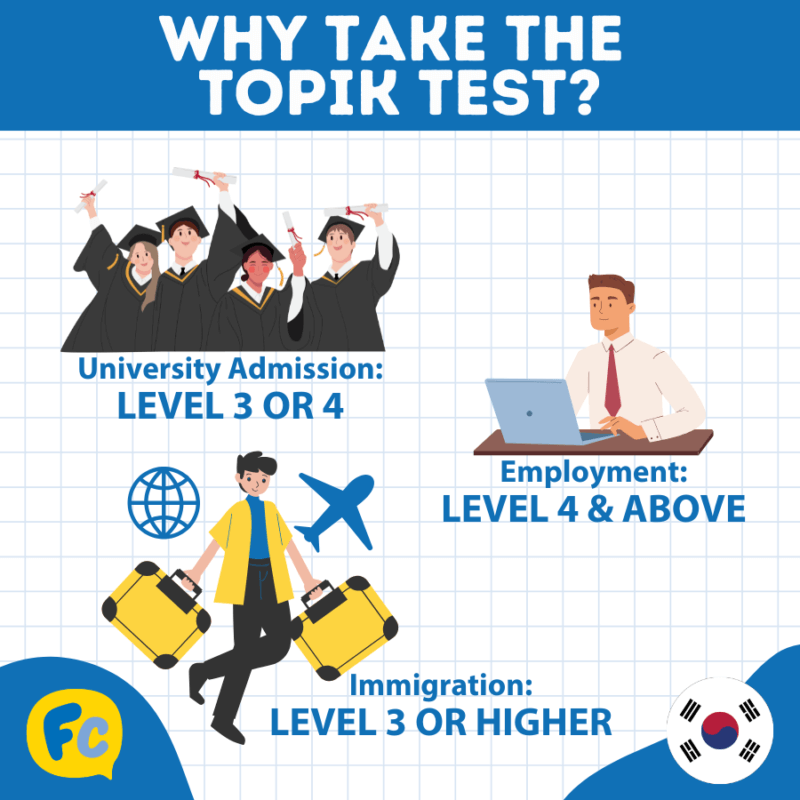
TOPIK TEST | Why Take the TOPIK Test?
The TOPIK is useful for various reasons, some common reasons people will take TOPIK are:
University Admission
Most Korean universities require international students to submit TOPIK scores as part of the admission process.
The required level typically depends on the program, but many undergraduate and graduate programs require at least a Level 3 or 4.
Employment
Some companies in South Korea, especially those looking for foreign talent, often require job applicants to have a certain level of Korean language proficiency.
A TOPIK score at Level 4 or higher is commonly sought after for work in Korean companies.
Immigration
For foreigners seeking permanent residency or South Korean citizenship, the TOPIK test is often a requirement, particularly for proving an average language proficiency of Level 3 or higher.
Self-assessment
Even if you’re not planning to move to South Korea or apply for university, the TOPIK test provides good insight into your Korean level if you want to know which level of Korean you stand.
Now that you know what the TOPIK Test is, you can explore if taking this test would be an option for your Korean studies.
TOPIK TEST | PRACTICE QUIZ
We have compiled a database of the most common words found in TOPIK I and TOPIK II in order to create vocabulary quizzes.
Whilst this is not the official test, this quiz will help you review essential Korean words that you will definitely encounter during the official exam!
Choose the level you wish to practice:
TOPIK TEST | FAQs
What is the TOPIK test and who should take it?
TOPIK (Test of Proficiency in Korean) is a standardized Korean language test for non-native speakers. It’s ideal for students, job seekers, or anyone planning to study, work, or live in South Korea.
What are the different levels of the TOPIK test?
There are two types: TOPIK I (Beginner – Levels 1 & 2) and TOPIK II (Intermediate to Advanced – Levels 3 to 6). The higher your level, the more fluent and advanced your Korean skills are considered.
How can you study for the TOPIK Test?
There are published books in Korean bookstores or online. There are also sample questions you can study from the official TOPIK website: https://www.topik.go.kr/
Are there any special eligibility criteria for the TOPIK Exam?
Anyone who is studying Korean Language (at an institution or by self-study) can take the exam.
What is the validity period of the TOPIK score?
TOPIK score or certificate is valid for 2 years.
Want More From LTL?
FANCY LEARNING KOREAN? Check out our online Korean courses here.
We offer a 7-day free trial to all online students where you can study Korean 24/7.
Want to study Korean in Korea instead? Our Korean courses in Seoul can either be taken in small groups of no more than 5 students or individually for a more tailored experience.
We even offer incredible homestay experiences in Seoul too.
It doesn’t end here, sign up to the newsletter for even more free resources and news from LTL ⬇️