

 Spanish
 Italian
 French
 Russian
 Japanese
 Mandarin Simplified
 Mandarin Traditional
 Vietnamese
 Cantonese
 Shanghainese
 Taiwanese
Top Korean Girl Names and Their Meanings
Celebrate Beauty and Tradition – Discover The Meaning Behind Korean Girl Names!
✨ There is a famous Korean quote that reads:
호랑이는 죽어서 가죽을 남기고 사람은 죽어서 이름을 남긴다 (horangyi-neun jugeoseo gajug-eul namgigo saram-eun jugeoseo ireum-eul namginda).
This translates to when a tiger dies, it leaves behind its pelt; when a person dies, they leave behind their name.
From this ancient quote, we can see how significant names are for Koreans.
In this blog, we’ll explore the history of naming girls in Korea, as well as looking at popular Korean girl names in both the past and modern times and their meanings
⬇️ Interested in something specific? Clicking on the link will bring you to your preferred section!
Korean Girl Names | History of Naming in Korea
Korean Girl Names | Popular Korean Names in the Past
Korean Girl Names | Popular Korean Names Now
Korean Girl Names | What does 언니 (unni) and 누나 (nuna) Mean
Korean Girl Names | FAQ

History of Naming in Korea
Going way back in history, the importance of gender varied during different periods.
For instance, women played an important role during the 고려시대 (goryeo si-dae), or Goryeo Period (918–1392).
They retained their surnames, had economic freedom, could own property, and received equal inheritance alongside their siblings. In addition, women were able to remarry after their husbands passed away. Women also often cared for the elderly parents. Therefore, it was common for men to move into their wives’ homes, indicating a strong matrilocal society.

29 of the Best Korean Dramas to Binge Watch This Weekend
Don’t limit yourself to apps and books! Watching TV is also an efficient way to learn! Here is our selection of some of the best Korean dramas to study.
Moreover, children shared equal obligations to perform rituals after their parent’s demise. Despite being excluded from business and governmental roles, women in Goryeo were recognized as active and independent members of their households, and their voices were valued.
During the 조선시대 (joseon si-dae), or Joseon Dynasty (1392 – 1897) however, many of the advancements made for women and girls during the Goryeo period were reversed as the nation prioritized restoring Confucian traditions over Goryeo’s more liberal policies.
From then on, for many years to come Korea remained a male-dominated society. As a society deeply rooted in Confucian ideology, females had strict roles.
Their role was assisting their husband, handling house chores, and caring for the kids. Being a woman in a Confucian society wasn’t easy. In particular, if you are a female born in a lower social rank, you were given names without much consideration.
They will usually just give nicknames from the month they were born or from the sequence of birth.
Some popular names were 삼월이 (sam-wo-ri), 사월이 (sa-wo-ri), 오월이 (oh-wo-ri).
| Korean girl names | transliteration | Meaning |
|---|---|---|
| 삼월이 | sam-wo-ri | March child |
| 삼월 | sam-wol | March |
| 이 | yi | Particle added to a name |
| 사월이 | sa-wo-ri | April child |
| 사월 | sa-wol | April |
| 이 | yi | Particle added to a name |
| 오월이 | oh-wo-ri | May child |
| 오월 | oh-wol | May |
| 춘자 | chun-ja | Autumn child |
| 춘 | chun | Autumn |
| 자 | ja | Boy or child |
| 말자 | mal-ja | Last child |
| 말 | mal | Last |
| 자 | ja | Boy or child |

“Hwaiting” – The Korean Word with Multiple Meanings
Uncover Different Ways You Can Use 화이팅 (Hwaiting) in Korean! If you’ve ever visited Korea, watched a K-drama, or chatted with Korean friends, you’ve likely heard the word “Hwaiting!” 화이팅! Interestingly, it’s not a native Korean word — it…
After Korea became an independent country and faced rapid economic growth, many Koreans relied on 작명소 (jakmyungso) naming centers to create names. These name centers are still popular today. Yes, in Korea there are places people can actually go and pay others to create names.
The expert will study the Four Pillars of Destiny or 사주 (saju) in Korean to indicate what names will suit them. The Four Pillars of Destiny is a Chinese astrology that uses a person’s birth year, month, day, and hour to determine their destiny or fate based on two sexagenary cycle characters.
Some people will also change their names later in life if they feel that they are not in their best fortune with their original name.
Korean Pronunciation Rules // Tips and Tricks to Pronouncing Korean Correctly
Learning grammar and vocabulary is not enough if you can’t get yourself understood! Check out the Korean pronunciation rules to speak like a native.
Popular Korean Names in the Past
Traditional Korean names usually consist of three syllables, a surname, and two-character names, much like those of Chinese names. This is because Korea used 한자 (hanja) – traditional Chinese characters in the past before 한글 (hangeul) was created. 한자 (hanja) is still widely used today.
In the past many girl names ended with the character 자 (ja) which means boy in 한자 (hanja). There are two historical assumptions about why many women had 자 (ja) as the last character in their names.
The Japanese naming styles influenced many Korean names during the time Japan ruled Korea. Many Japanese girl names also consist of 자 (ja) at that time.
Another assumption is that as this character means boy, they named their daughters with a boy in it in hopes they will have more sons in the future.
Popular names during the 1940s to 1960s
영자 (young ja)
The meaning of the first character can vary depending on which traditional Chinese character was used. Some common characters were 영(young, 英) meaning flower beak, or 영(young, 瑩) which means bright.
순자 (soon ja)
The most popular character for this name is 순 (soon, 順) which means gentle, and 순 (soon, 淳) which means pure or clean.
옥자 (ok ja)
For the character, most girl names used 옥(ok, 玉) which means jade.
미자 (mi ja)
For this character, most girl names used 미 (mi, 美) which means beautiful.
6 Important Korean Proverbs to Know for Daily Life
Korean proverbs is one of the best way to get familiar to the country’s culture and history. Lots of them are about food, but who is surprised about that?
Popular Korean Names Now
Pure Korean names without 한자 (hanja) are becoming increasingly popular.
Names derived from pure Korean words are either formed by combining two characters from specific words or by using a segment of words from a phrase.
For instance :
| Korean girl names | transliteration | Meaning |
|---|---|---|
| 슬아 | seul-ah | Name derived from “wise” and “beautiful” |
| 슬기로움 | seul-gi-roh-eum | Wise |
| 아름다움 | ah-reum-da-eum | Beautiful |
The name is given to a newborn girl in hopes she carries these two traits in life.
| Korean girl names | transliteration | Meaning |
|---|---|---|
| 아란 | ah-ran | Name derived from “beautifully” and “grown” |
| 아름답게 | ah-reum-dap-ge | Beautifully |
| 자란 | ja-ran | Grown |
Name was given to a girl to become a beautifully grown woman.
다온 (da-on) is a name commonly created from using a segment of a phrase from the sentence:
좋은 모든 일이 다 온다 (jo-eun mo-deun il-ee da on-da)
This sentence translates to every good thing will come.
They used the two words 다온 (da-on) from 좋은 모든 일이 다 온다 (jo-eun mo-deun il-ee da on-da)
| Korean | transliteration | Meaning |
|---|---|---|
| 모아 | mo-ah | Name derived from “always gather good things” |
| 늘 | neul | Always |
| 좋은 | jo-eun | Something good |
| 일 | il | Thing |
| 모아라 | mo-ah-ra | To gather, collect |

Best Apps to Learn Korean // Our Tremendous 12 for 2025
There have never been so many language learning apps on the market that nowadays! We analysed the best apps to learn Korean in 2021, so you don’t have to.
What does 언니 (unni) and 누나 (nuna) Mean
In Korea and other Asian countries, you won’t always call people by their names.
If you are a girl and calling an older female, you will address her as 언니 (unni). You can sometimes put their name in the front of 언니 (unni).
For example:
리아 언니 안녕!English: Hi Leah!
| Korean | transliteration | Meaning |
|---|---|---|
| 리아 | ria-eonni-annyeong | Name |
| 언니 | unni | Word to address an older female |
| 안녕 | an-nyeong | Casual form of hello |
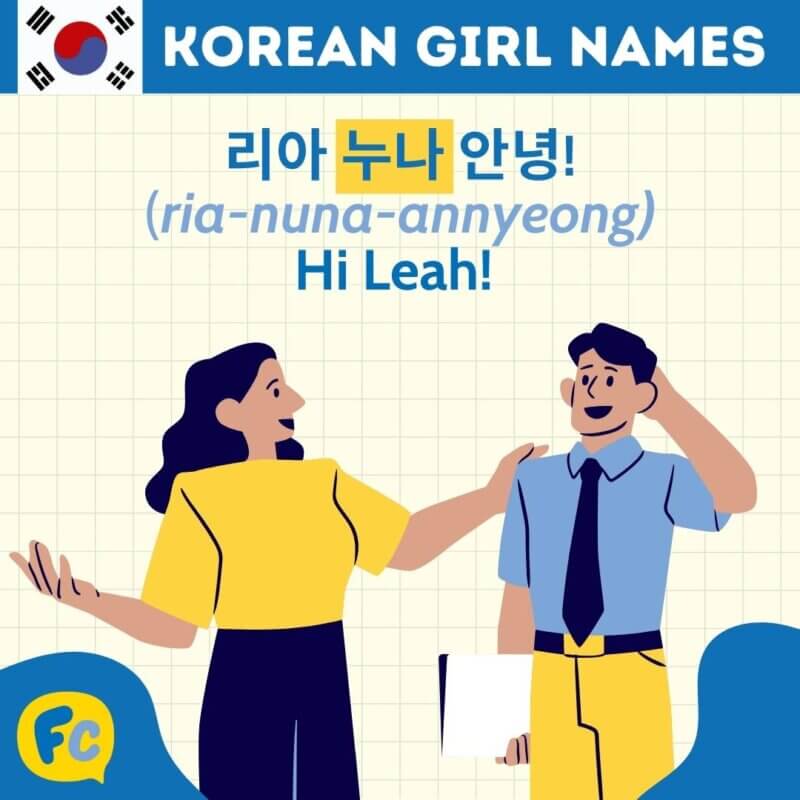
If you are a boy and calling an older female, you will address her as 누나 (nuna).
This term is commonly used in Korean culture to show respect and affection towards older sisters or female friends. It reflects the importance of hierarchy and relationships in Korean society, where age plays a significant role in how individuals interact with one another.
Using the correct form of address not only demonstrates politeness but also helps to strengthen social bonds. In many families, boys will often refer to their older sisters as 누나, establishing a close and caring relationship.
리아 누나 안녕!English: Hi Leah!
| Korean | transliteration | Meaning |
|---|---|---|
| 리아 | leah | A Korean girl name |
| 누나 | nuna | Word to address an older female |
| 안녕 | an-nyeong | Casual form of hello |
TOP – BONUS | Interested in Girl Names from different countries? Take a look at our comprehensive guide to Chinese names and find out the most common surname in China!
You can also explore how names function in Vietnam with our guide to Vietnamese names.
Korean Girl Names | FAQ
How are Korean girls names structured?
Korean names typically consist of a family name (surname) followed by a given name, which is usually two syllables. For example, in the name Kim Ji-eun (김지은), “Kim” is the surname, and “Ji-eun” is the given name.
What do Korean girls names usually mean?
Each syllable in a Korean name often corresponds to a Hanja (Chinese character) with its own meaning. Names are carefully chosen for their meanings, which often reflect qualities like beauty, wisdom, or strength.
How do you say ‘Chinese character names’ in Korean?
한자 이름 (hanja ileum)
한자 (hanja) – Chinese characters
이름 (ileum) – name
What are some popular Korean girl names today?
Some currently popular names include Seo-yeon (서연), Ha-eun (하은), Ji-woo (지우), and Ye-seo (예서). Trends in naming can shift over time, often influenced by celebrities and K-dramas.
Want More From LTL?
FANCY LEARNING KOREAN? Check out our online Korean courses here.
We offer a 7-day free trial to all online students where you can study Korean 24/7.
Want to study Korean in Korea instead? Our Korean courses in Seoul can either be taken in small groups of no more than 5 students or individually for a more tailored experience.
We even offer incredible homestay experiences in Seoul too.
It doesn’t end here, sign up to the newsletter for even more free resources and news from LTL ⬇️