

 Spanish
 Italian
 French
 Russian
 Japanese
 Mandarin Simplified
 Mandarin Traditional
 Vietnamese
 Cantonese
 Shanghainese
 Taiwanese
A Quick Guide to Understanding Korean Money
Everything You Need to Know About the Korean Currency
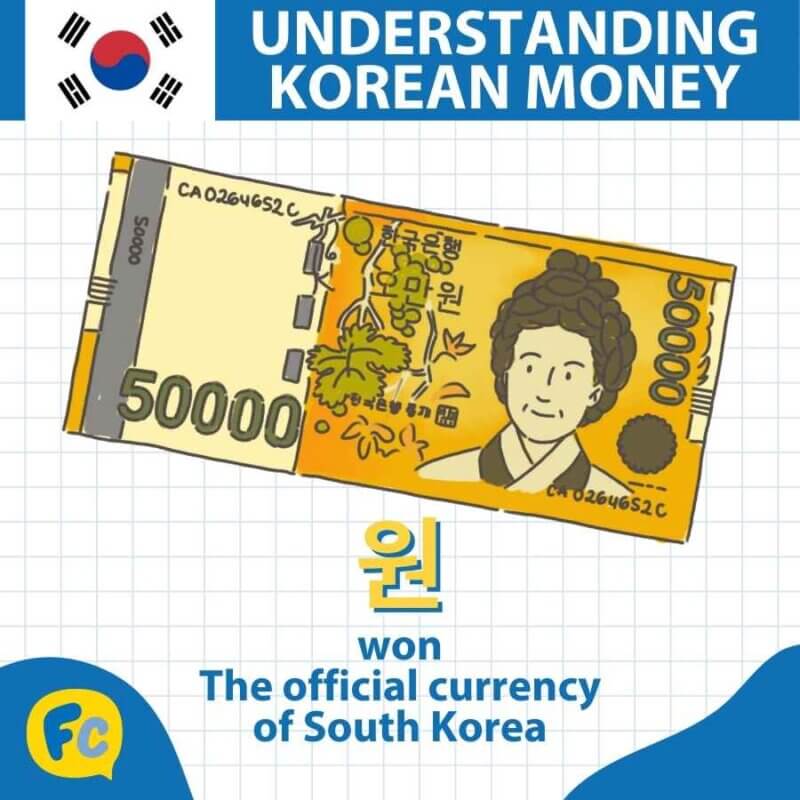
Korean money, known as the 원 , won, ₩ or KRW, is the official currency of South Korea.
With the rise in popularity of Korean pop culture, tourism is booming in the country.
Money is a helpful thing to be clued up on before visiting any country and Korea is no exception!
If you plan to visit South Korea soon, this blog will tell you everything you need to know about Korean money, including how to count it and useful Korean vocabulary.
Understanding Korean Money | What is the South Korean Won?
Understanding Korean Money | Denominations of South Korean Won
Understanding Korean Money | How to Count Korean Money
Understanding Korean Money | A Brief History of the Korean Won
Understanding Korean Money | How to Use Korean Money
Understanding Korean Money | FAQ

Understanding Korean Money | What is the South Korean Won?
The South Korean won (KRW) is the currency used in South Korea, with the symbol “₩” and the international currency code “KRW.”
The won was introduced in its modern form in 1962, replacing the South Korean 환 or hwan, which was used from 1953 to 1962.
Today, the Bank of Korea (BOK) or 한국은행 (han-guk-eun-heng) is responsible for issuing the currency, managing the money supply, and overseeing the country’s monetary policy.
Understanding Korean Money | Denominations of South Korean Won
The South Korean won consists of both coins and banknotes. The smallest unit of currency in South Korea is ₩1 also referred to as 1원 (il-won) in Korean. Here’s a breakdown of the different coins and notes you’ll find in South Korea:
동전
Coins| 10원 | ship-won | Ten won or ₩10 |
| 50원 | oh-ship-won | Fifty won or ₩50 |
| 100원 | baek-won | One hundred or ₩100 |
| 500원 | oh-baek-won | Five hundred or ₩500 |
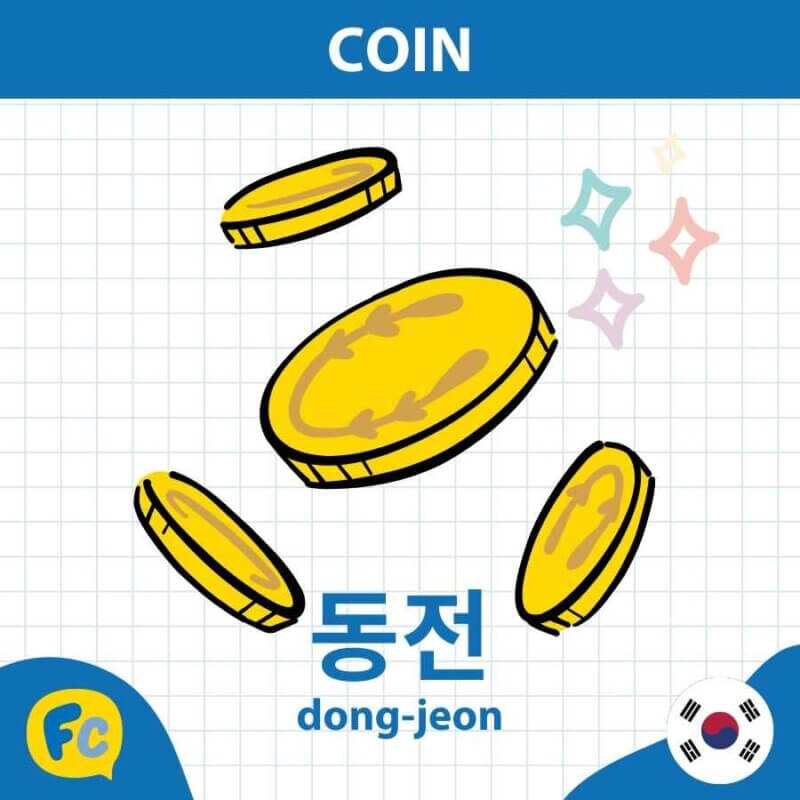
The highest denomination for coins, ₩500 coins are common for purchases of small items like candies or small snacks.

지폐
ji-pae
Banknotes
천원
cheon-won
One Thousand Won ₩1,000
Although it seems like a big number, this is the smallest banknote.
One USD is roughly equal to 1,300 won.
오천원
Five Thousand Won ₩5,000Often used for slightly higher everyday purchases, like coffee.
₩5,000 is roughly 4 USD.
만원
Ten Thousand Won ₩10,000₩10,000 is roughly 7 USD.
오만원
Five Thousand Won ₩50,000The highest denomination banknote in regular circulation.
₩50,000 is roughly 36 USD.
₩50,000 is typically used for larger transactions or when withdrawing money from an ATM. Due to its high value, some vendors might be reluctant to give change for it in smaller stores.

How To Spend A Day In Koreatown NYC
Your ultimate guide on what to do, the best places to eat and drink and where to shop for Korean language and Kpop merchandise in Koreatown NYC.
Understanding Korean Money | How to Count Korean Money
Here’s a simple guide on counting the South Korean won:
1. Basic Counting
Korean money works in multiples of ten. For instance:
₩10 is ten won
₩100 is one hundred won
₩1,000 is one thousand won
₩10,000 is ten thousand won
Keep in mind that ₩1,000 is a little less than $1 USD, so prices in South Korea can appear quite high when expressed in won, but actually aren’t that pricey.
For values higher than ₩10,000, numbers are typically grouped in tens of thousands.
For example:
| ₩100,000 (one hundred thousand won) would be written as 십만원 (sip-man won). |
| ₩1,000,000 (one million won) would be written as 백만원 (baek-man- won). |
| ₩10,000,000 (ten million won) is 천만원 (cheon-man-won). |

This system of grouping can be tricky for those used to smaller denominations in Western currencies, but practice makes perfect. Try to get used to the Korean currency before traveling so it will confuse you less.
You can also use shortcuts such as estimating ₩1,000 as $1 to get a rough conversion.
Understanding Korean Money | A Brief History of the Korean Won
The history of South Korean won dates back to the end of World War II, when Korea was divided into North and South. Both territories had their own currency. It later would temporarily be replaced by a currency called hwan.
The won was reintroduced on June 9, 1962. It became the only legal currency in South Korea on March 22, 1975.
Understanding Korean Money | How to Use Korean Money
In daily life, South Korean transactions are carried out using both cash and electronic payments.
While credit and debit cards are widely accepted in urban areas like Seoul and Busan, cash is still king in many traditional markets, smaller towns, and for certain services like taxis or street vendors.
If you’re traveling to South Korea, here are some key points to remember:
– Cash or Card: While most businesses accept credit cards, you’ll want to have some cash on hand for smaller transactions, especially in more rural areas.
| 현금 | hyun-gum | Cash |
| 체크카드 | chek-kad | Debit card |
| 신용카드 | shin-yong kad | Credit card |
| 통장 | tong-jang | Banknote |

If you want to ask if this place accepts cards or cash, you can say:
카드 결제되나요?
kad gyul-je-dwe-na-yo
Do you accept cards?
현금 결제되나요?
hyun-geum-gyul-je-dwe-na-yo
Do you accept cash?
If you want to pay by cash you can say:
현금 결제할께요
hyun-geum guyl-ge-hal-gge-yo
I will pay by cash

Many card transaction machines in Korea need manual card entries into the machine. If the cashier points to the card machine, you can place the card inside yourself.
Security and protection for card use in Korea are very strict, especially when purchasing through the Internet. You will find it common that many stores only take payment from domestic credit cards.
– ATMs: ATMs are widely available throughout South Korea, though not all accept foreign cards. Those that do are usually marked with signs in English and will charge a small fee for withdrawal.
현금 자동 입출금기
ATM machines현금
hyun-geum
Cash
입출금
ip-chul-geum
Deposit and withdrawal
자동
ja-dong
Automatic
기
gi
Machine
Koreans also say :
ATM기
ATM gi
ATM machines
기
gi
Machine
– Tipping Culture: Tipping is not customary in South Korea, so you won’t need to worry about adding extra money to your bills for services like dining or taxis.
Conclusion
Whether you’re visiting South Korea for the first time or planning to start a business with South Korean companies, understanding how the won works is essential.
Now that you are familiar with the currency, practice using it with real Korean money!

Places in Korean | 100+ Useful Words for Beginners
Get a head start by learning the most common places in Korean and the vocabulary related to some of them. The bank, hospital and more. You’ll be ready.
Understanding Korean Money | FAQ
How do you say expensive in Korean?
비싸요 (bi-ssa-yo) – expensive
너무 비싸요 (neo-mu bi-ssa-yo) – It’s very expensive
How do you say cheap in Korean?
싸요 (ssa-yo) – cheap
How do you say, I don’t have cash in Korean?
현금이 없어요 (hyun-geum-yi eop-so-yo) – I don’t have cash
Want More From LTL?
FANCY LEARNING KOREAN? Check out our online Korean courses here.
We offer a 7-day free trial to all online students where you can study Korean 24/7.
Want to study Korean in Korea instead? Our Korean courses in Seoul can either be taken in small groups of no more than 5 students or individually for a more tailored experience.
We even offer incredible homestay experiences in Seoul too.
It doesn’t end here, sign up to the newsletter for even more free resources and news from LTL ⬇️