

 Spanish
 Italian
 French
 Russian
 Japanese
 Korean
 Mandarin Simplified
 Mandarin Traditional
 Vietnamese
 Cantonese
 Shanghainese
 Taiwanese
Japanese Punctuation: A Beginner’s Guide
From Question Marks to Commas: Japanese Punctuation Explained
When learning Japanese, you might focus on kanji, hiragana, katakana and phrases but equally important are the punctuation marks.
Japanese punctuation plays a significant role in shaping the readability and flow of written text.
Though it has its origins in Chinese characters and Japanese calligraphy, modern punctuation in Japanese has been influenced by Western writing styles.
In Japanese, there are many expressions whose nuance changes greatly depending on how punctuation marks are used. Punctuation marks also play an important role as an expressive technique in anime and manga.
In this article, we will introduce punctuation marks and symbols for writing in Japanese. By becoming familiar with them, you will be able to gain a deeper understanding of Japanese texts and manga.
Japanese Punctuation || Full Stop
Japanese Punctuation || Comma
Japanese Punctuation || Question Marks
Japanese Punctuation || Interpunct
Japanese Punctuation || Dashes
Japanese Punctuation || Ellipsis
Japanese Punctuation || Exclamation Mark
Japanese Punctuation || Quotation Mark
Japanese Punctuation || Parentheses
Japanese Punctuation || FAQs

Japanese Punctuation || Full Stop
“。” is called “句点[くてん] kuten. This mark is used to indicate the end of a sentence. Its function is similar to period in English. There is no need to put a space after a kuten.

私はジョンです。
[わたしはジョンです。]
Watashi wa Jon desu.
I’m John.
これはジュースです。
Kore wa ju-su desu.
This is juice.
Because of its shape, kuten is sometimes called 丸 まる maru (a circle).
In English, to emphasize that you have said a full sentence, you say “…, period.”
In Japanese, the equivalent expression is まる.
今日は終わり、まる。
きょうはおわり、まる。Kyou wa owari, maru.
Today is over, period.
Dialogue in manga may or may not be punctuated. This depends on the publisher. In chat tools, multiple kutens are sometimes used to create a sense of lingering impact or implication, but this is not official.
今日は行けません。。。
きょうはいけません。。。Kyou wa ikemasenn…
I can’t go today…
Japanese Punctuation || Comma
“、” is called “読点 とうてん touten. This mark is used to separate clauses or items in a list, much like the comma in English.
私が買ったのは、ぶどう、バナナ、リンゴです。
わたしがかったのは、ぶどう、バナナ、リンゴです。Watashi ga katta nowa, budou, banana, ringo desu.
I bought grapes, bananas, and apples.
Kuten and touten are collectively called 句読点 くとうてん kutouten.
Japanese Punctuation || Question Marks
Just like English, ? クエスチョンマーク is used to indicate that the sentence is about a question. In Japanese this is called 疑問符 ぎもんふ gimon-fu.
In Japanese, however, you don’t necessarily have to add the mark to the end of a question sentence because “か” at the end can work just like question marks. Question marks are used to clarify that you are asking something.

これはなんですか?
kore wa nandesuka?
What is this?
あれはどんな本ですか。
Are wa don-na hon desuka.
What kind of book is that?
Because Japanese has the particle ka and many other words to express questions, question marks tend not to be used much in text messages or chats.

15 Japanese Tongue Twisters with Romaji and Audio 🗣️
Want to improve your Japanese pronounciation and have fun doing it? Check out these 15 Japanese tongue twisters with accompanying videos.
Japanese Punctuation || Interpunct
“・” is called “中黒[なかぐろ] nakaguro/ interpunct.”
This is most commonly used to indicate word boundaries when writing foreign proper nouns in katakana.

ハリー・ポッタ
ー hari-・potta-
Harry Potter
ター・ウォーズ
suta- wo-zu
Star Wars
ジョン・スミス
jon- sumisu
John Smith
Interpunct is also used when listing several elements together.
日本の大都市は、東京・大阪・名古屋などです。
[にほんのだいとしは、とうきょう、おおさか、なごやなどです。]
Nihon no daitoshi wa toukyou, oosaka, nagoya nadodesu.
The major cities in Japan are Tokyo, Osaka, and Nagoya.
ランチの定食は、松・竹・梅の三種類です。
ランチのていしょくは、まつたけうめのさんしゅるいです。Ranchi no teishoku wa matsu, take, ume no sanshurui desu.
There are three types of lunch set meals: Pine, Bamboo, and Plum.
Japanese Punctuation || Dashes
In Japanese, a tilde-like symbol 〜 is used to indicate long sounds and ranges.
疲れた〜
つかれた〜tsukareta-
I’m tirrred.
4月〜5月
しがつからごがつshigatsu kara gogatsu
From April to May
Long sound can also be written as ー. 〜 is used to indicate a little bit longer sound. 〜 is also used to show that someone is speaking in a lazy manner, without ending the sentence clearly.

スーパーマーケット
su-pa-ma-ketto
Supermarket
おつかれさまです〜
otsukaresamadesu-
Thank you for your hard work
When used to indicate a period of time, it is used even in formal documents, but when used to indicate a long vowel, it is casual.

Japanese Pick Up Lines 😉 28 Ways To Raise Your Japanese Rizz
Let’s learn some Japanese pick up lines together. We have a huge total of 28 Japanese chat up lines that will break the ice with your crush! Let’s discover.
Japanese Punctuation || Ellipsis
“…” is called “三点リーダ さんてん – santen.” It is used in a similar way as in English, to indicate an omission, an unfinished thought, or a pause.
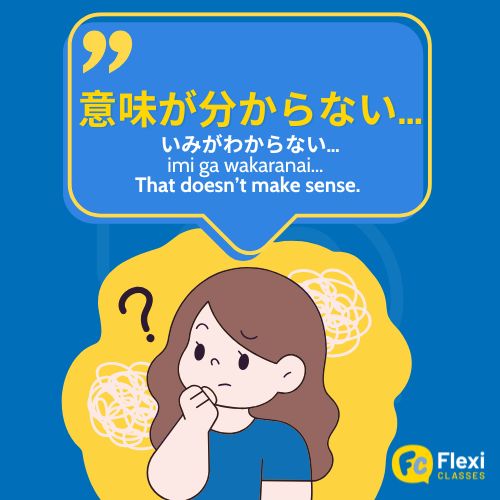
意味が分からない…
いみがわからない…imi ga wakaranai…
That doesn’t make sense.
It’s sometimes used alone in chat to express being at a loss for words or dumbfounded. Similar usage is often seen in manga.
Japanese Punctuation || Exclamation Mark
“!” is also used in Japanese. This one is called 感嘆符 [かんたんふ] kantan-fu or ビックリマーク (bikkurimaaku). This is used to express strong emotion, excitement, or emphasis.
In formal Japanese it’s often avoided.
すごい!sugoi!
Amazing!
Japanese Punctuation || Quotation Mark
In Japanese, quotation marks are written as “「 」”, called kagi kakko かぎかっこ .
They are used to indicate direct speech or to quote material, similar to double quotation marks (” “) in English. These brackets can also be used for highlighting specific words or phrases.
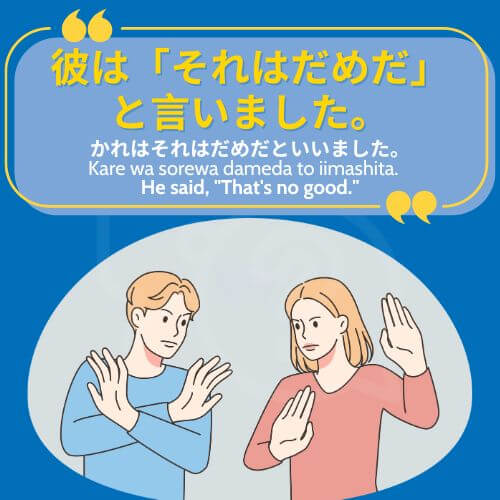
彼は「それはだめだ」と言いました。
かれはそれはだめだといいました。Kare wa sorewa dameda to iimashita.
He said, “That’s no good.”
この町は「東洋のベニス」と呼ばれています。
このまちはとうようのベニス」とよばれています。kono machi wa touyou no venisu to yobareteimasu.
The city is known as the “Venice of the East.”
Japanese Punctuation || Parentheses
Japanese uses full-width parentheses ()(かっこ) to add additional information, clarification, or notes, just like in English.
私は昨日(か一昨日)散歩に行きました。
わたしはきのうかおとといさんぽにいきました。Watashi wa kinou ka ototoi sanpo ni ikimashita.
I went for a walk yesterday (or the day before yesterday).
電車(東京行き)は6時に出発します。
でんしゃとうきょういきはろくじにしゅっぱつします。Densha (toukyou iki) wa rokuji ni shuppatsu shimasu.
The train (for Tokyo) leaves at 6 o’clock.
The first ( is read かっこ and the second) is read かっことじる .

How to Use a Japanese Keyboard // A Super Simple Guide
How to use a Japanese Keyboard? How to type in Japanese? Where can I find a Japanese keyboard? We answer all of these questions and more.
Japanese punctuation may seem subtle compared to Western punctuation, but its nuances add depth to written language.
Whether you’re reading a novel, a manga, or a newspaper, understanding how these symbols work will help you comprehend and express the meaning more effectively.
Punctuation is just as important as the words you use, so take the time to familiarize yourself with these symbols. With practice, you’ll find that they’re not only functional but also contribute to the beauty and rhythm of the Japanese language!
Is there any difficulties with Japanese punctuation happened to you? Tell your story here!
Japanese Punctuation || FAQs
What is the equivalent of a period or a comma in Japanese?
。is equivalent to a period, and 、to a comma.
Are question marks and exclamation marks used in Japanese?
Exclamation marks and question are used also in Japanese.
What are quotation marks in Japanese?
Quotation marks in Japanese are 「」. These are called かぎかっこ kagikattko.
Is there anything unique to the Japanese language?
ー and 〜, which are used to indicate long sounds or a period of time, are not used in English.
How do you say “interpunct” in Japanese?
Interpunct is called 中黒 なかぐろ nakaguro in Japanese.
Want More From LTL?
WANT TO LEARN JAPANESE? Check out our online Japanese courses here.
We offer a 7-day free trial to all new students where you can study 24/7.
What about studying Japanese in Japan instead? We’ve got your back. Our Japanese courses in Tokyo can either be taken in small groups of no more than 5 students or individually for a more tailored experience.
We even offer incredible homestay experiences in Tokyo as well.
Come and be a part of this amazing community.